Showing posts with label churches and monuments. Show all posts

Thursday, 15 September 2016

Some notes on familiar spirits


I read James Serpell’s piece on familiar spirits, ‘Guardian Spirits or demonic Pets: The Concept of the Witch’s Familiar in Early Modern England, 1530-1712, which appeared in Angela Creager and William Jordan’s The Animal/Human Boundary: Historical Perspectives (2002). It’s a thorough job, with some very good quotations and a jolly chart of the various animal forms the devil was said to have adopted.

The sources of bemusement remain: where such a strange idea came from, and in particular why it was English witchcraft that so featured the diabolic familiar in animal form.

It’s useful first to remind oneself of a widespread psychological phenomenon:
The Wikipedia writers paraphrase  from Klausen and Passman, ‘Pretend companions (imaginary playmates): the emergence of a field’ in the Journal of Genetic Psychology (2006): “Adults in early historic times had entities such as household gods and guardian angels, and muses that functioned as imaginary companions to provide comfort, guidance and inspiration for creative work.”

After a non-Christian origin, a conceptual and etymological inevitability operated to produce the familiar spirit in animal form.

In Roman times, Ronald Hutton explains, you had a lares familiares, a guardian angel called your genius (a woman might have referred to hers as her natalis Juno). On your birthday, you made special vows and little sacrifices to your geniusor juno on the household shrine, the lararium. Emperors, meanwhile, had a numen, and their re-union with their numen at death was what made a dead emperor into a god. Evil spirits, says Lemprière, were the Larvae or Lemures. They were considered to be the spirits of the dead, and ceremonies, Lemualia, were performed to keep them in their graves or make them depart. These evil spirits are just a general supernatural nuisance; they are not assigned to living individuals as opposites to the genius.

The genius is considered by some lexicographers to link to the word jinn. In Moslem tradition, Jorge Luis Borges explains, Allah created three forms of intelligent beings: angels, from light, the jinn, from fire, and humankind, from earth. The jinn can be evil. They manifest, Borges reports his sources as saying, first of all as clouds or undefined pillars, then can stabilise or condense into a human or animal form, as jackal, wolf, lion, scorpion, or snake – definitely not as domestic animals. Jinn can overhear angelic conversations, and so pass on second hand vatic information to wizards. But the harms attempted by an evil jinnee are easily defeated by invoking the name of Allah, the all Merciful, the Compassionate.

For the European tradition, the OED’s etymologies take the story forwards. In post-classical Latin of the 12thcentury, the guardian angel is the angelus familiaris. Because the culture was Christian, and that culture was intensely given, after Prudentius’ hugely popular 5th century Christian poem, to analysing the psychomachia, the battle happening in and around an individual soul, familiar devils followed, c.1464. You now have both a Good and a Bad Angel, like Faustus, and they form a morally effective pairing, as in this illustration:


A court scene, with the person testifying between his evil and good angels.
From Ulrich Tengler, Der neü Leyenspiegel (Strassburg, 1514)


The OED assigns spiritus familiaris to the 15th century, and has the term in its English form from 1545. EEBO can be used to add further quotations. The “familier spirit of a mannes awne minde” is mentioned quite neutrally in the translation of Erasmus’ commentary of Cato’s precepts in 1553, while 1554 provides the more opprobrious “one that had a familier spyrit, and used enchauntry” in a work by Richard Smith.
Of course, the neutral use is in commentary on a Roman writer. In the context of magic, the familiar spirit may have set off like the daemon of Socrates, being the source of your knowledge. But when that knowledge was forbidden, no neutral ‘daemon’ is possible: it is a demon informing you (or, more likely, misinforming you).
Lurking in familiar was a connection to the house: Latin, familiaris,‘of a house, of a household, belonging to a family, household, domestic, private’. Canis familiaris is the domestic dog.

The Roman lares familiaris or penates were represented in the form of dancing human-shaped figures, who carry a libation cup and dish. But when the familiar spirit is no longer a daemon but a demon, no longer a geniusbut an evil genius, a witch-hunter can infer that, as it would be instantly incriminating to have a largely human-shaped devil visible in the household, the devil is going to be present either invisibly, or disguised in animal form.

Genesis, as it had been interpreted from the second century, gave ample warrant for Satan assuming animal form. Nobody could imagine Jesus appearing to them in the form of a dog, but part of satanic debasement was non-angelic form. Milton has his Satan suavely passing from cormorant, to tiger, to toad, to serpent, as best serves his advantage. Intelligent writers of Genesis-based poems, like Du Bartas and Milton, were fascinated in just how Satan could get a snake to speak. Du Bartas even seems to imagine that one way round this difficulty is that Satan, invisible, is ‘playing’ the serpent, like a brilliant musician coaxing a good sound from a poor musical instrument (Sylvester, translating Du Bartas, interjects an allusion to John Dowland’s ability to coax harmonious music out of a broken-down old instrument).

Imputed 'devil's door', Warfield Church, Berkshire


I think that the medieval church in general down-played the genius or ‘good angel’. They are mentioned, but really they occupied a role the church wanted for itself: leaving aside special miraculous interventions by the Blessed Virgin Mary, the church is the best protector. Having promoted itself to guardian-angeldom, the church would naturally incline to emphasise what you were being so well protected from. As an instance, on the Heritage Open Day this last weekend, I cycled to Warfield Church in Berkshire, which has one of the reputed ‘devil’s doors’. It is asserted that such small doors, in the North wall of a church, were opened during the medieval Catholic baptismal rite – involving exorcism – of a baby in the font placed near to the devil’s door. Subsequently, ‘devil doors’ tended to be walled up: in the Reformation, it is said. Maybe very early Christian buildings had a North-side door for the not-yet baptised, and the feature was reproduced in later buildings. An exorcised devil flying out of an aperture is such a common motif that such doors probably did at some later time have that different function in a drama of exorcism (absurd though it is for a spirit to require a doorway). This is a separate issue; my point is about the church’s tendency to make the devil familiar. The devil was inside you prior to your baptism, and he is always trying to resume control, he will always be close at hand.

Once the devil had become multiplied into vast numbers of evil spirits, every sinner can have one, and the church can busy itself beating them away. Some irremissible sinners, demonology began to say, struck personal covenants with devils. Invisible devils inevitably had a neither-here-nor-there quality. It became the duty of the person accused of witchcraft, or the person who said they were bewitched, to see devils. Particularly in England, and perhaps because the English always seem to have accommodated an odd range of animals living with them, animals already in the house were co-opted as devils; or in the absence of animals, the assumed attendant devils were assigned animal forms by those who claimed to be witnesses, or by witches who were trying to confess compliantly enough to worm their way back into judicial favour.


The sinister, vice, element from psychomachia had in effect combined with the household suggestions of ‘familiaris’(“some domestical or familiar devil” in Daneau, A Dialogue of Witches, 1575) to suggest that the spirit prompting to evil adopted disguise as a domestic animal, as when Elizabeth Stile confessed that when she went to gaol, “her Bunne or Familier came to her in the likenesse of a black Catte” (1579). The OED does not include this sense for the noun ‘bun’, but it was in regular early modern use, alongside ‘imp’, as in Great News from the West of England: “In the Town of Beckenton … liveth one William Spicer, a young Man about eighteen Years of Age; as he was wont to pass by the Alms-house (where liveth an Old Woman, about Fourscore) he would call her Witch, and tell her of her Buns; which did so enrage the Old Woman, that she threatened him with a warrant…”

If the church had appropriated the role of good genius, we can then see Milton’s Comus as powerfully re-instating the guardian angel, the daemon, sent direct from heaven to intervene - because Milton was well on the way to his repudiation of organised worship.

I think the most revealing familiar spirits are those whose forms and actions are recounted in Edward Fairfax’s Daemonologia. I say this because Helen Fairfax, the writer’s eldest daughter, was simply making them up, deliberately and in a calculated fashion, to get her father’s attention. Yes, reported familiars were always made up, but in this case there’s no ambiguity about delusions, or hysteria, or deception by a third party. Helen Fairfax simply let rip, unleashed her imagination and expanding on themes she’d heard in other reports.

She witnessed a Protean devil: human formed, then a beast with many horns, then a calf, then “presently he was like a very little dog, and desired her to open her mouth and let him come into her body, and then he would rule the world”
Her father is completely credulous. On the 16thNovember, 1621, a black dog, she said, had leapt onto her bed “and I tried if I could feel the dog, but I felt nothing; and the wench said ‘The dog has leaped down and gone’ ”

Then there is Margaret’s Wait’s alleged familiar “At last the woman pulled out of a bag a living thing, the bigness of a cat, rough, black, and with many feet”. This alarmingly non-tetrapodic beast keeps trying to sit on the Bible Helen is conspicuously attempting to read.

More imaginative is the black cat: “when the cat opened her mouth to blow on her, she showed her teeth like the teeth of a man or woman”. This imaginary being mixes together the devil in animal form and the witch who, in her animal form, is incompletely transformed.

The women that Helen Fairfax so heedlessly accused were taken for examination. No supernumerary teats were found on them, and they were acquitted when tried. The relentless Helen, who is making all this up, subsequently sees a witch breast-feeding her familiar, and is indignant at this crafty way of escaping exposure. She has come up with a way the women at the York assizes escaped proper detection. Finding her lies officially disbelieved only caused Helen to rally with more lies.

What moved Helen Fairfax was said to be paternal neglect. She maybe also took some pleasure in deceiving a father who had no regard at all for her intelligence. A desire to be married and away from home is also apparent. Satan appears to her as a gallant gentleman. The God himself appears to her in the hall. This is too much for the family, who can believe in the devil being present, but not God himself, and Helen swiftly adjusts her story, as the God who appeared to her produces evasive answers, and finally shows his horns.


Wednesday, 11 May 2016

Troublesome disguises: the Goddard monument at East Woodhay Church


Over to this slightly remote church (for the area) last night
http://www.stmartinschurch.hampshire.org.uk/rental.htm
at East Woodhay, justly rated for its acoustics and the total quiet outside, to listen to Stile Antico perform this concert
http://www.stileantico.co.uk/concerts/2016/05/10/the-touches-of-sweet-harmony-6
of Shakespearean or Shakespeare-inspired music. No plans, apparently, to release a CD, which I was very sorry to hear. Byrd's 'Tristitia et anxietas' was new to me, and overwhelming. They must at some time (surely) release Nico Muhly's 'Gentle sleep', a setting of words - snatches of text- from Henry V (IV i), a clever reduction of Henry's self-serving orotundities into something moving, with wonderful writing for high soprano and bass.

But the surprise in the church was this memorial to the left of the altar:


The inscriptions tell you all I know:

"Near this place lies the body of Edward GODDARD Esq, son of Wm GODDARD Esq, late of this parish, by Elizabeth his wife who was the daughter of John D’OYLE Esq, an ancient and honourable family in the county of Oxford. He married Elizabeth the daughter of Edward GODDARD Esquire of Ogbourne St Andrews in the County
of Wilts, by whom he had no issue.
He was a person of sober life and conversation, constant in his devotions both publick and private, whom neither the pleasures of the age did lead into excess, nor the vices corrupt.
By his last will he testified his respect for the House of God both in this parish and in that of his Manor of Castle Eaton in the County of Wilts in both of which parishes the poor also will receive lasting tokens of his charity
He died the 7th day of October 1724 aged 65.

Elizabeth GODDARD, relict of Edward GODDARD Esq, a pious and charitable lady, by her last will left one hundred pounds, the interest whereof to be layd out by the Minister and Church Wardens in Linen for the poor of this parish.
With this money and twenty pounds added were purchased lands in Ashmansworth viz one toft and eight acres of bond land in the fields there and Redland Coppice and lands in Privet Field, Wm RIME, Tennant in Trust, for the uses aforesaid.

She died the 30th day of September 1732 aged 72."

The couple must have been related, outside the regulations about consanguinity, a Hampshire Goddard marrying a Wiltshire one. Their full-length figures are slightly smaller than life-size, but so raised up as to suggest the grand manner. 


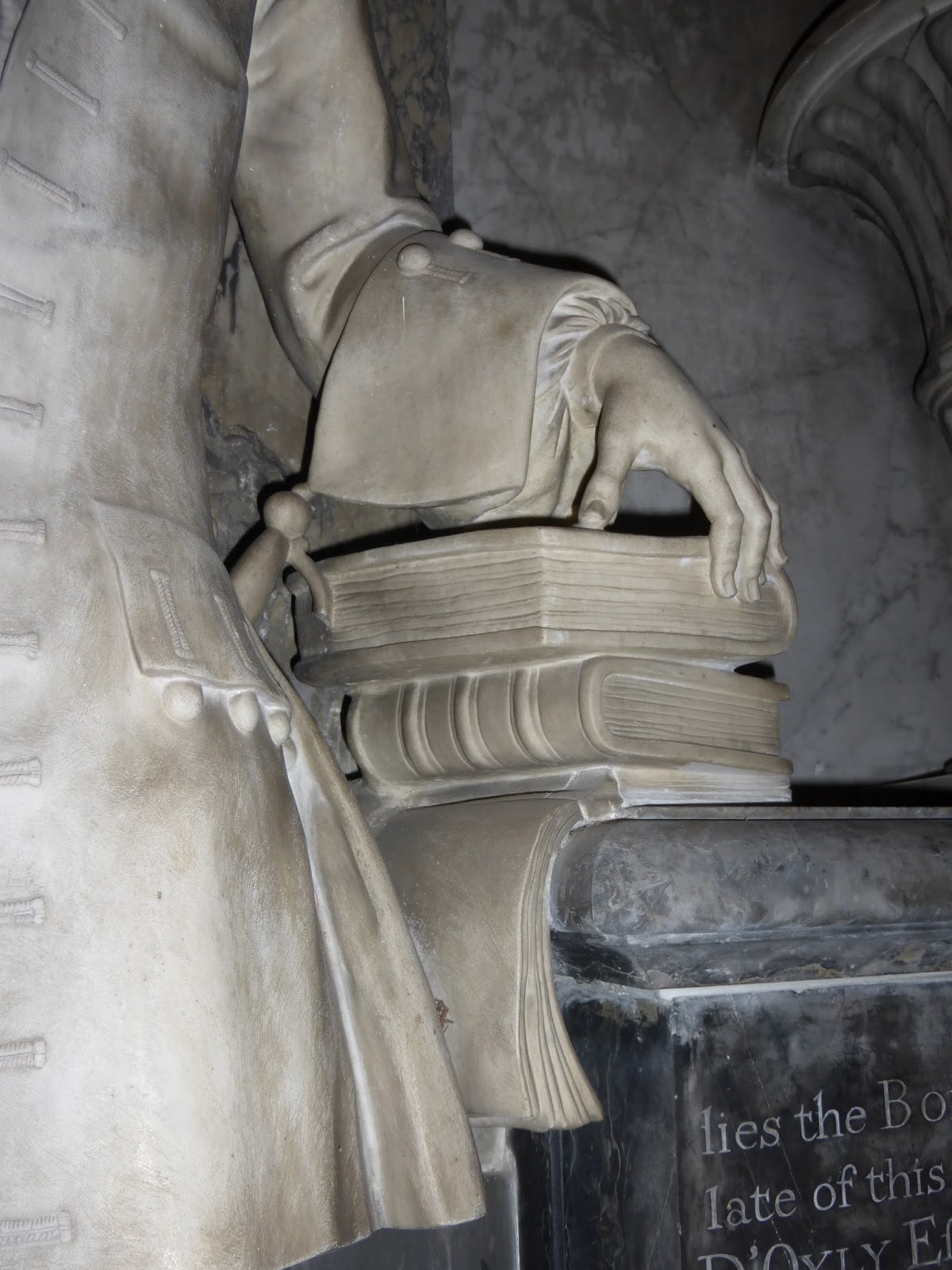
Edward and Elizabeth are a Gainsborough couple before Gainsborough; squirearchy out of Fielding or Hogarth. As the inscription tells us, Edward married Elizabeth "by whom he had no issue", so the memorial lacks the usual rising tide of offspring. To validate themselves, Edward has his sword and books:


He looks out into the world. Elizabeth is given no extra attributes: she is just herself (except that she looks at her husband, so that in some senses he validates her). But she is striking, erect and proud, rising from her drapery like an English Minerva:


The eyes, undrilled, make her remote. I'm interested in the contrast of their clothes: hers, tempestuous, make his look geometrical. The sculptor gave full detail:


I suggested 'Minerva', but further reflection might suggest that these attires, these 'troublesome disguises which we wear' cast him as reason, her as passion. He has her (however), safely corralled off at the church's east end.


I liked the self-approval, the complacency: they were no doubt charitable and pious, but they loom over the altar in proprietorial fashion. "He testified his respect for the House of God" by condescending to be there, in life and thereafter.


In this review of an exhibition of swagger portraits, Andrew Graham-Dixon  speaks of a "streak of solemn, anti-theatrical, empirical grand manner portraiture": 

Here it is in a Hampshire Church monument. I wonder what they were like! Absorbed, really, in the specifics of land-ownership, I guess.


Wednesday, 18 December 2013

Lady Margaret Savile's monument, Hurst.

Back in September, because of one of those days where people cycle to raise money for charity round as many churches as they can, I was able at last to get inside a church I have ridden or driven past many times, the Church of St Nicholas in Hurst, Berkshire, just to the east of Reading. I must have had a notion that a church so consistently locked might have something inside worth seeing, and so it proved, a sensational set of monuments.

Chief among them is this extravaganza commemorating Lady Margaret Savile, who died at the age of 73 in 1631. She is in the centre, facing her third and most distinguished husband, Sir Henry Savile, Mathematician, Astronomer, Historian of Science, translator (in his lodgings at Merton, the '5th committee', responsible for the Gospels, Acts of the Apostles, and the Book of Revelations in the King James Bible met, Savile's knowledge of Greek making him the only layman involved in the translation).

We can perhaps imagine the two of them are praying over open copies of the text he helped produce. Savile had died in 1622, Margaret had erected a monument to him in Merton College Chapel. The brochure available in the church cites Elias Ashmole as saying that there was formerly an infant in a cradle in front of them. The monument says she had two sons by Savile, who both died young.

To the left in this matriachal frieze are the figures on two of Margaret's daughters: Lady Anne Carleton (from her first marriage to George Garrard) and Lady Elizabeth Sidley, her daughter by Savile.

To the right are the figures of Lady Francis Harison, youngest of her daughters by her first husband, and her husband Sir Richard Harison of Hurst. The whole monument is here because Margaret wanted 'to deposite her body in the place where living she had found soe much content & soe sweet a repose in her age' - she had lived with this couple in Hurst in her final years.


The solidity of these figures, their prayerful calm, is offset by a great swagger of marble drapery, with angels and cherubs pulling aside or lifting the curtains to disclose this undramatic scene of family prayer:


Studded here and there are the shields that spell out the dynastic stuff, and further cartouches crown the whole structure, this monument that is almost a building

Urns, shields, tassels, strapwork, fringes, inscriptions, curlicues, ribbonwork, scrolls, swags: it is the very height of early 17th century taste, that taste for which the quip that 'less is more' never had any meaning: more is more.

It is Lady Margaret's own monument. It commemorates her three husbands, but depicts just the last (I guess it must be the case that while men can freely have themselves depicted between wives, a widow could not have a line-up of her late spouses without some indecorum of effect). Sir George Savile is not here given any particular allusions to point to his achievements in learning, the angels are not indicated to be allegorical. This stony splendour is a fossil of her taste. The impression one has of matrilineage is perhaps wrong: three daughters are indeed present, but we should remember that the top order of the monument did originally commemorate one of the lost infant sons, and the remaining five of Margaret's nine children (two male, three female) are in smaller and now headless effigies below the rank of inscriptions:
.

Monday, 23 September 2013

'My worst of fates attends me in my grave': joining Lord Rochester at Spelsbury

An interesting weekend for me: on Saturday, I was one of the group of old members of the college had taken up the invitation to return to Jesus College on (just about) the 40th anniversary of our matriculation.

Here I am at breakfast: 'Self portrait in a convex teapot':


On Sunday morning, despite feeling that port has yet to have its moment as an energy drink, I drove out to Eynsham, got my second best bicycle out of the car, and headed off to Chastleton House (NT). It's a lovely old place, and my sister last year was re-gilding the clock face from the courtyard, so I was minded to see that back in place. But I got there early, and was going to have to wait three-quarters of an hour with a dreadful thirst, so I switched to Chipping Norton, where I felt sure there would be a cafe, and where I was minded to see the Rickards tomb in the church:


It is beautifully done, though like many of these things, it has attracted the graffiti of idling youths with knives in their pockets. I wonder if it were fully restored, would a restorer have to leave the incised graffiti, which have become a kind of town record?


The tomb side tells us that Thomas Rickards had died in 1579. Elizabeth Rickards, nee Fiennes, lived until 1603, but was still living when the monument was erected, and they never got round to filling in the blanks - but that she would not outlive the millenium had occurred to the person doing the lettering:


As usual, the drapery on the recumbent figures does not hang, and I can only suppose that this shows the strength of conventional depiction: whoever executed this fine piece of sculpture would have been able to render hanging drapery, but somehow that would not have done. Elizabethans liked the starchy look. This is the mastiff at Elizabeth's feet.


I then decided to loop back to Spelsbury, where John Wilmot, Lord Rochester is buried. I didn't know if there would be a ledger slab, or a wall memorial. In fact, neither: Rochester was placed in a vault under the church. This had been opened back in the 1960's or 70's, and the coffin lid's brass plate, a memorial plate from the coffin, and a lead tablet from his wife's grave were taken and put on display inside the church:


The vault was entered from the north side of the church: I went to have a look, and noticed that the cement holding the quite ordinary garden centre paving slabs that covered the vault entrance was completely loose, and the slabs cracked. I lifted two pieces aside:


Below, I could see that an iron grating was propped against the passageway into the vault underneath the church:


And at this moment, common sense prevailed: if I squeezed into this narrow gap, and got stuck down there, nobody knew where I was, there was no mobile phone signal even at ground level, I had no torch, and why on earth did I think that visiting Milord's pocky bones was a good idea?

 ... Dead, we become the Lumber of the World,  
And to that Mass of matter shall be swept,  
Where things destroy'd, with things unborn, are kept. 
Devouring time, swallows us whole  
Impartial Death, confounds, Body, and Soul.

It would, arguably, have been a suitable end for a literary scholar ('After a long search, Dr Booth's remains were found in the vault where the libertine poet, John Wilmot, had been buried in 1680. He was still clutching Rochester's pelvis.') 


Saturday, 13 October 2012

'Perfection fæminine' at Shorwell Church (or maybe not).


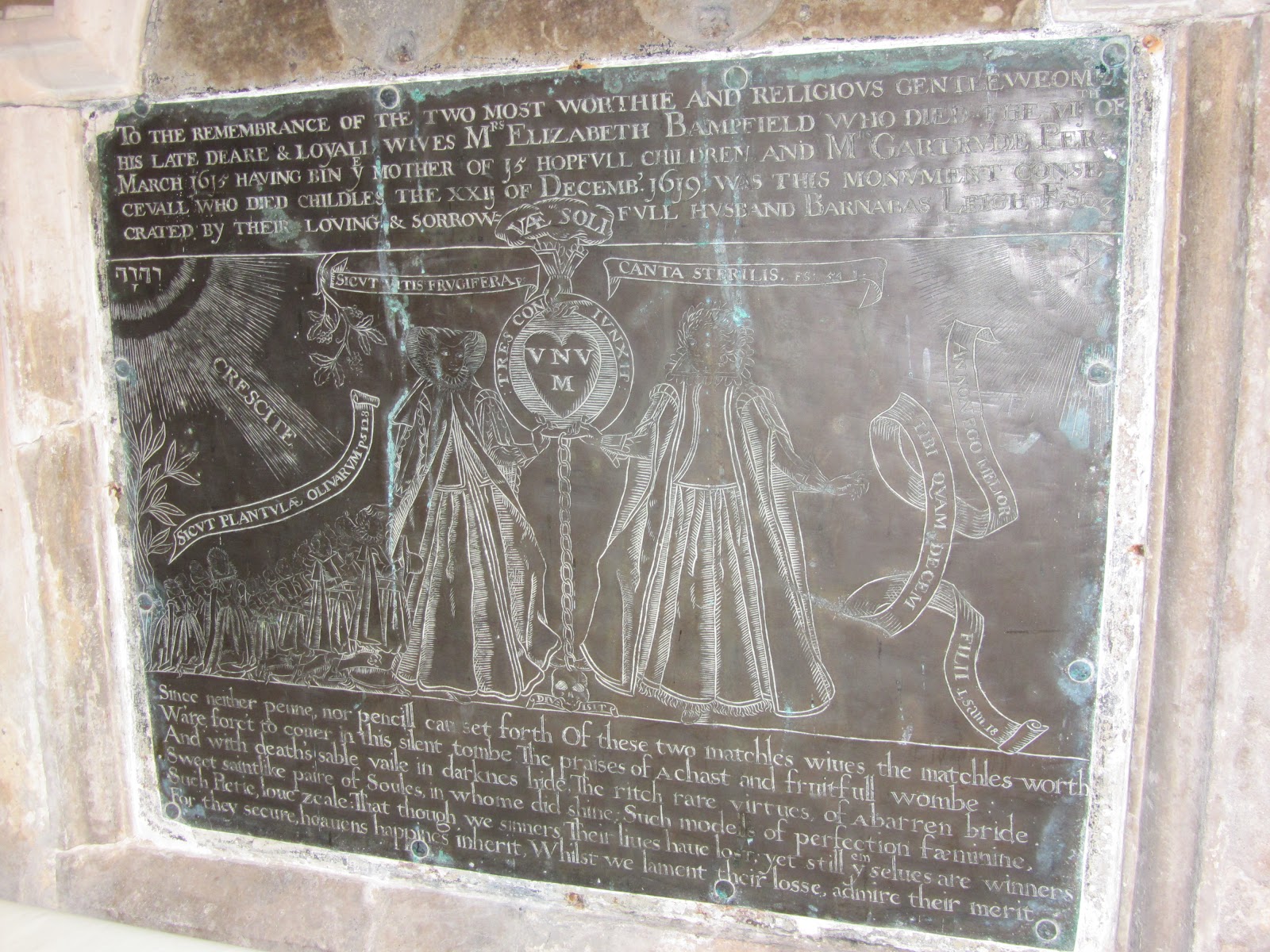
Life’s a bit too busy to trawl up oddities from the depths of EEBO, so another post about a Jacobean monument, one that I found remarkable. It’s a brass plaque in Shorwell church, on the Isle of Wight. It (just maybe) conveys a double message – alongside the quite sincere tribute-in-general, may be some hints of a more complicated story.

Top and bottom of the plaque are these two texts, which tell the facts:

“To the remembrance of the two most worthie and religious gentleweomen his late deare & loyall wives Mrs Elizabeth Bampfield who died the VIIth of March 1615 having bin ye mother of 15 hopefull children and Mrs Gartrude Percevall who died childless the XXII of December 1619 was this monument consecrated by their loving & sorrowfull Husband Barnabas Leigh Esq.”

I have re-lineated the lines at the bottom:

Since neither penne, nor pencill can set forth
Of these two matchles wives the matchles worth
W’are forc’t to cover in this silent tombe
The Praises of a chast and fruitfull wombe:
And with death’s sable vaile in darknes hide,
The ritch rare virtues of a barren bride.
Sweet saintlight paire of Soules, in whome did shine
Such models of perfection fæminine,
Such Pietie, love, zeale: That though we sinners
Their lives have lost, yet still [them]selves are winners
For they secure, heavens happiness inherit,
Whilst we lament their losse, admire their merit.


In between the two main texts, the pictorial part of the plaque shows the two women, Elizabeth with her shoal of fifteen behind her, kneeling in primary and secondary ranks by gender, the ten boys first, the girls behind. Her hand touches the bared head of the eldest son. From the normal post-Reformation ‘depiction’ of God, ‘Jehovah’ in Hebrew letters, the divine command ‘Crescite’(‘Increase’) shines down on the male children. Gartrude is of course on her own, but the 'Chi Rho' symbol for Christ shines down on her. 


Between the two women, a male gloved hand breaks the word ‘Sorrow=full’ in the memorial inscription, and is itself inscribed ‘vae soli’ – ‘woe alone’. The hand supports, with the left hand of Elizabeth and Gartrude’s right hand, a ring, with the motto ‘tres conjunxit’ (‘three joined, coupled’) around a heart, the heart with the motto ‘Unum’ – ‘one’. A chain descends from the ring to a death’s death (‘divisit’ – ‘it divided’), but, in a nice detail, both women have a foot, rather jauntily, on the death’s head, as a modest expression of their triumphant ascent to eternal life.


As is quite normal in portraits of the time, text is just about as important as depiction, and we have plenty more to read. Barnabas Leigh had searched his Bible for texts suitable to honour both his wives. Divine light shines on Elizabeth, and she gets “Sicut Plantulae Olivarum ps128” as one of her mottoes (on the scroll to her left), and above her head, “sicut vitis frugifera”. Both are from Psalm 128, verse 3: “Thy wife shall be as a fruitful vine by the sides of thine house: thy children like olive plants round about thy table.

Gartrude was more challenging, perhaps, but an ideal text was located: “Canta Sterilis PS 54 1” – Psalm 54:

1 Sing, O barren, thou that didst not bear; break forth into singing, and cry aloud, thou that didst not travail with child: for more are the children of the desolate than the children of the married wife, saith the Lord.
2 Enlarge the place of thy tent, and let them stretch forth the curtains of thine habitations: spare not, lengthen thy cords, and strengthen thy stakes;
3 For thou shalt break forth on the right hand and on the left; and thy seed shall inherit the Gentiles, and make the desolate cities to be inhabited.
4 Fear not; for thou shalt not be ashamed: neither be thou confounded; for thou shalt not be put to shame: for thou shalt forget the shame of thy youth, and shalt not remember the reproach of thy widowhood any more.
5 For thy Maker is thine husband; the Lord of hosts is his name; and thy Redeemer the Holy One of Israel; The God of the whole earth shall he be called.
6 For the Lord hath called thee as a woman forsaken and grieved in spirit, and a wife of youth, when thou wast refused, saith thy God.
7 For a small moment have I forsaken thee; but with great mercies will I gather thee.

The other text for Gartrude is more interesting – but really sets a challenge about where to stop an interpretation. One notices that she is depicted pointing to the text with her free hand, in a balancing gesture to Elizabeth’s hand blessing her eldest son. Gartrude’s text is “An non ego melior tibi quam decem filii 1 Sam 18”.


This takes us to the start of the First Book of Samuel – the text is the last part of this extract:
1 [Elkanah] had two wives; the name of the one was Hannah, and the name of the other Peninnah: and Peninnah had children, but Hannah had no children …
… 4 And when the time was that Elkanah offered, he gave to Peninnah his wife, and to all her sons and her daughters, portions:
5 But unto Hannah he gave a worthy portion; for he loved Hannah: but the Lord had shut up her womb.
6 And her adversary also provoked her sore, for to make her fret, because the Lord had shut up her womb.
7 And as he did so year by year, when she went up to the house of the Lord, so she provoked her; therefore she wept, and did not eat.
8 Then said Elkanah her husband to her, Hannah, why weepest thou? and why eatest thou not? and why is thy heart grieved? am not I better to thee than ten sons?”
The Bible story is one of an awful rivalry over fertility between two wives: Peninnah/Elizabeth producing children, Hannah/Gartrude weeping, and not eating, always under the lash of her rival’s provoking tongue.
Obviously, Barnabas Leigh did not, like Elkanah, have two wives at once. He had found the perfect text for Gartrude in the splendid promises made by the Lord himself in Psalm 54. A further text was gratuitous: he could have quoted twice from the one Psalm, as was done with Elizabeth. Was it the intention to indicate that Elizabeth’s success in multiple births (and how eloquent of the uncertainties of child survival at the time is that regular locution about “hopefull children”) oppressed Gartrude as second wife? Out of a Bible context rich in implications (if implications were meant), chosen for the plaque was that strong affirmation of a husband’s love “An non ego melior tibi quam decem filii” – ‘am not I better to thee than ten sons?’


Look at how the artist depicted the ‘fruitful vine’ to the left of Elizabeth’s head: it’s actually a sprig of holly. I know holly has Christian meanings, but I do wonder at the substitution of spiky holly leaves for vine leaves.
In the Book of Samuel, poor oppressed Hannah prays in the Temple – Eli the priest thinks she is drunk, for her prayers are spoken in her heart – her mouth moves, but she makes no sound. Her silence in prayer contrasts her to the sharp-tongued Peninnah. The reward for her faith is the longed-for pregnancy – she will be the mother of Samuel, whom she dedicates to the Lord who lent him.

Of course, any woman who has endured fifteen (and possibly more) pregnancies is entitled to have a sharp tongue and (within the general parameters of an undeniable success at “perfection fæeminine” in regards to that divine command “crescite”) be rather a challenge to her husband.

I have most likely over-read this monument – but it went out of its way to invite reading, didn’t it?


Wednesday, 3 October 2012

At Boxgrove Priory: the de la Warr chantry


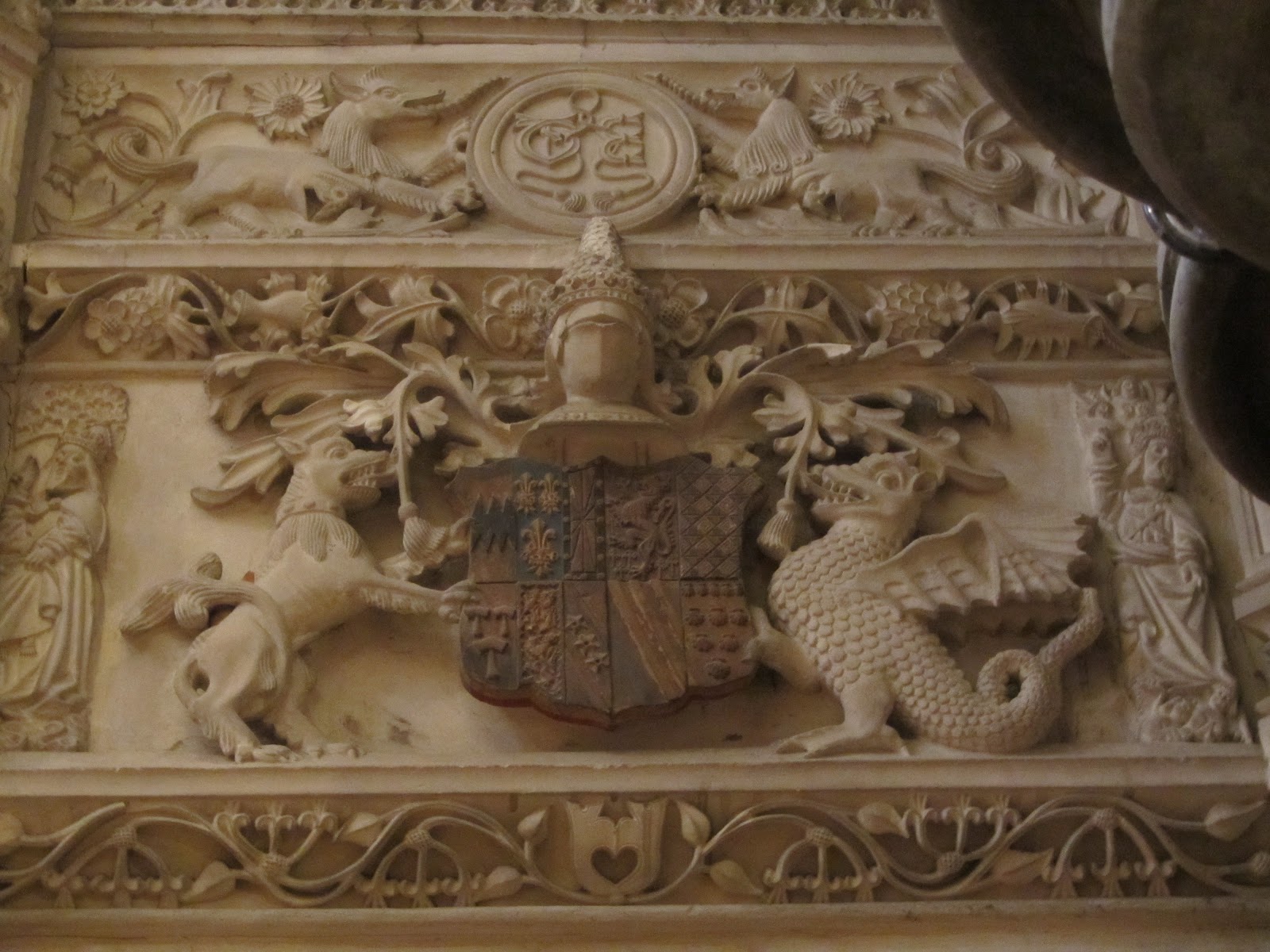
I managed to get along to Boxgrove Priory on Sunday, where the chantry chapel set up by Thomas West, “eighth Baron West and ninth Baron de la Warr” (1472–1554) is the big feature. It’s dated to 1532, and de la Warr intended it as a final resting place for himself and his wife, with a chantry priest to say masses for their souls in purgatory.

So far, so perfectly late-Medieval Catholic. History and Henry VIII overtook this project: Boxgrove was abruptly dissolved as a priory. Thomas West tried in vain to get it exempted, then settled pragmatically for retaining the main priory building as a parish church. But even then, the long-lived de la Warr was never to be buried in the beautiful personal shrine he'd had erected. Accused of playing a part in a conspiracy, he had to swap his local manor house, to which the king had taken a fancy, for a former nunnery at Whewell in Hampshire. That was the price of his pardon for an invented crime. Leaving Sussex, he left this chapel behind him, though I imagine he wondered about having it taken apart and transported.

It had been a daring piece of work just getting the chantry in the church and close to the altar: a whole pier was removed, with the double size arch above it strengthened – even so, load bearing vaults no longer sweep down to approach the absent column, but splay across almost horizontally. Everything hovers above this miracle of faith, and has done so without trouble for nearly 500 years.

What a piece of work it is, eloquent of so much. The decoration mixes the heraldry of the de la Warre family, Tudor roses, and faith. It its original state, viewers must have seen a structure that ascended up from a joyous motifs of the fleshly world – fat cherubs play lutes, two young men swarm up one column, throwing down fruit to a girl who holds out her apron. Hercules fights the Nemean lion, a King and Death stand either side of a tree, dragons writhe.


Then above this, the divine realm: the riotously decorated columns, turn into their structural negatives, niches for with saints topped with intricate Gothic canopies. Heaven is held up by faith, not stone. Sinuous movement turns to fixity, the contemplation of God - music might come from heaven without visible performers, certainly not from fat-legged cherubs. All the saints disappeared, of course: the empty niches conjure them up, spectacular victims of all that jostling life down below them, martyred again in effigy. I imagine their battered torsos will be in a pit somewhere close at hand, maybe dug down to the paleo-surface where Boxgrove man and his fellows slaughtered extinct animals half a million years before.


Decorative motifs for the carvings were apparently taken from a French Book of Hours. The lively realm of classical motifs, images from fabliau and moral tale, and stiff Tudor roses seem to be pushing the Gothic world higher towards heaven. Though to an extent, the  elaborate coats of arms and Orders of the Garter aspire towards joining the building’s divine realm: angels obligingly display dynastic honours.

The intricate vaulting within makes it seem as if the masons could extrude stone through an icing nozzle or fresh pasta maker. As decorative as a gypsy caravan, the chantry stayed where it was and journeyed forwards through time.


Sir Thomas Wyatt could have gone down to Chichester and seen this structure when it was new. Anne Boleyn was about to become queen. Of its time in its jollity, its Tudor patriotism, all of the certainties of its theology were about to be stripped away. The double sized arch held up: the metaphorical roof fell in.

Sunday, 24 June 2012

“After this they fell all to dancing the Hays, about three flower-pots”: welcoming the apocalypse in Berkshire, 1650.


My text is a Thomason tract. Only ‘…ber’ for the month appears in his title page dating, it was perhaps September, certainly the 20th of the relevant month.

A most faithful relation of two wonderful passages which happened very lately (to wit, on the first and eighth days of this present September, being Lords days) in the parish of Bradfield in Berk-shire 1650.

The London writer has a preamble, in which the millenarian hopes entertained by Dr John Pordage and his wife are represented as (inevitably) the devil’s work prospering in Berkshire, just as they are prospering everywhere as never before:

“This is an Age of wonders: for I dare affirme, that since the deplorable Fall of our first Parents, at which time Sin was first ushered into the World, the ill spirit was never so busie, he never made such a harvest, or had such a latitude of power given him to ramble up and down in any part of the earth, as he hath had lately in this island; witness else in what various forms he hath appeared, and what sundry feats he hath played in Essex, Suffolk, Cambridge-shire, and other places, especially in Scotland, where thousands have been possest by him, and so brought to the Gallows: And now it seems he hath taken footing in Berk-shire, as appears by these two uncouth Examples following.”

The writer renders Pordage’s name as ‘Doctor Pordich’ (making me wonder how often you would give, in those spelling-permissive days, a subtly denigratory spelling to a person’s name – ‘poor ditch’). John Pordage, as his ODNB life makes clear, was only just holding on in the regular church. The ‘Commissioners for ejecting of Scandalous Ministers’ would finally oust him in 1655. Pordage seems to have been involved or interested in the Family of Love, was prone to denunciations of marriage, was accused of denying the Trinity, was a Behmenist; while the ‘Everet’ named here as the likely ‘conjurer’ who has directed the devil to make these possessions in Berkshire, was actually John Everard - Leveller, Grindletonian, alchemist, etc, etc.

So, what would be represented as diabolic intrusion into parish life in Berkshire was really product of Pordage’s earnest and ecstatic belief that the heavens were about to open. Marvellously, he was in his pulpit preaching when it became somehow apparent to him that the big moment had come, and he exited his church then and there, anxious to get back to where the real action was going to be:

“Doctor Pordich being preaching in the Parish-Church of Bradfield (on the eighth of this instant September, being Lords day) within a quarter of an hour he fell into a Trance, running out of the Church, and bellowing like a Bull, saying that he was called, and must be gone.”

In its small way, it is a moment with something of the significance of the famous time when Mohammed turned his followers round during worship, away from Jerusalem, and towards Mecca. The Vicar of Bradfield exits his church, to be translated into heaven from home, along with his true followers - his wife, and some of their female friends. In his case, it proved not to be so epochal.

Understandably, when he left his church at such a moment in such a state, Pordage was pursued and questioned, but only replied that he must be gone ‘home to his house’. Fortunately, William Foster (a local gentleman rich enough to own a coach) followed Pordage home and witnessed what happened when the vicar got home:

“Where being come, he going up the Stairs, found his Wife, (Mistress Pordich) Clothed all in White Lawne, from the crown of the head, to the sole of the foot, with a White Rod in her hand.”

What’s pleasing about all this is that the apocalypse seems to be egalitarian in regards to gender. Now Pordage had heterodox views about marriage, and ambiguous relations with a number of women. He probably regarded his women followers as being in a state higher than marriage anyway. But at this moment, his wife (in the eyes of the normal world) Mistress Pordage, is garbed as a prophetess, and will soon call for ‘Elijah’s mantle’. Female followers gather: “Mistress Chevill coming in fell on her knees, saying, That she was to meet with her Spouse, and her Prophetess. After this comes in Mistress Tracie, holding of her head, and making of strange noyses, that were heard within her, in a very hideous passion. After this they fell all to dancing the Hays, about three flower-pots…”

Mr Foster, who has followed from church, asks Pordage what is meant by the dancing, and learns that “It was a rejoicing, because they had overcome the Devil.” Of course, joy that you have vanquished Satan in Berkshire can easily be represented in London as Satan’s victory over you. Perhaps there is a Familist touch in Mistress Chevill arriving to meet ‘her Spouse’ – Christ? Pordage? Though being the man he was, Pordage was inclined to deny that there was very much significant difference.

“With that his Wife cries out for Elijah’s Mantle, and then comes up Mistress Chevill, and Mistress Pordich fell of adoring her; and then in came one Goodwife Pukerig, and bended her body, and kissed her knee; Mistress Pordich assuring her that there was a place prepared for her in heaven, to sit at the right hand of the Virgin Mary.”

‘Elijah’s mantle’ because of the second book of Kings, verse 11: “And it came to pass, as they still went on, and talked, that, behold, there appeared a chariot of fire, and horses of fire, and parted them both asunder; and Elijah went up by a whirlwind into heaven.” Mistress Pordage is ready to ascend to heaven without death, as happened to Elijah. (“Knowest thou that the Lord will take away thy master from thy head to day?”)

But, as usual with these moments when the rapture is about to commence, there’s a snag – someone is missing, and it seems that this someone, who perhaps was important in making up the right numbers, was Foster’s own wife. Foster, having seen enough, leaves, but is urgently sent after and asked to return, bringing his wife with him. With her husband very much awake to strange goings-on, Foster’s wife gets cold feet, and simply refuses to go. In his 1655 publication, Innocencie appearing, through the dark mists of pretended guilt, Pordage over-confidently (and very conveniently) cites all the charges that were made against him, and in that work, it sounds as though Mistress Foster was rather frightened by the thought of seeing the heavens opened, as had been promised. As for Foster himself, he was probably involved at some lesser level himself. His wife having refused to answer the summons to be present at this Pang Valley ascension into heaven, Foster “tooke his Coach, and went alone: so coming into the Doctors house, he found the Doctor sitting in a Chaire all in black Velvet.” Costumes, as ever with early modern culture, were important for the show – as prophetess, Mistress Pordage has head to foot white linen, and her husband, black velvet (costly material and dye!). The mantle of Elijah itself was probably still in a wardrobe waiting to be deployed.

Asked where his wife is, Foster says she is not well, and therefore she cannot come: “Then said the Doctor, there is nothing can be done without her.” Crisis indeed! Mistress Pordage also asks the coachman, and hears confirmation that it is all going wrong. But they seem to have endeavoured to prolong the celestial window of opportunity, perhaps in hope that Mistress Foster would relent and show up just in time: “So there they keep dancing of the Hayes, and Trenchmore, and expecting when they shall be taken up to heaven every hour.”

The writer concludes with a dark imputation – Everard, as witch, was directing all this from far away: “By what means this Distraction came, is not as yet certainly known; but it is thought it was done by one Everet (a man suspected to be a Sorcerer or Witch) who much-frequented the Doctors house, and would often play with the children; and he was seen at London in a frantick posture, much about the time that these things happened.”

The little tract has ‘two wonderful passages’, however. Out of a sense of social status, the London  writer has told the story of Doctor Pordage’s folly first. He then moves on to detail what had happened the week before in the very same parish church. As this had happened to a thirteen year old youth, an illiterate member of a poor man’s large family (well, illiterate for the moment, but that all would change), it became the secondary story. The writer has relegated the one of the local signs that probably triggered Pordage to announce the apocalypse from its proper chronological place. Something of this sort wouldhappen in Pordage’s church: on Sept 1st, a youth of 13, “son to one Goodman Snelling”, “being in the Parish-Church of Bradfield, fell into a very strange Fit, foaming at the mouth for the space of two hours.”

Now to fall into a fit and foam at the mouth seems to me a very likely reaction to one of John Pordage’s sermons – he seems to have been a preacher worth hearing, wildly unpredictable, charismatic, full of novel doctrines, and easily misunderstood. The youth, whose sanity has probably been affected by listening to Pordage preach every Sunday,  finally emerges from his fit, and announces that he must go to London, taking his father with him. In London, they will find an old man there “living without Temple-bar, and said to be a Gold-smith”) who was “possest with two devils, and had the Root of Corruption in him.”

Exactly what you’d want to visit London to do – to locate the root of corruption. One can perhaps sense Pordage’s influence here, and a touching willingness on behalf of his young parishioner to come up with some marvel to interest his raving vicar. Exactly as foretold, they do indeed find the old man, who has been lying in a trance, from which he revives at the very instant that they arrive. This mysterious personage gives them yet more bewildering instructions: they are to go to Beacon Hill (it is just south of Newbury, close to Highclere house, aka Downton Abbey), “and there he should finde, at such a place, a crooked stick lying on the ground, and in it there should be an Inkhorn and a pen, and directions how to write and read, and to speak several Languages, and by the stick should be lying a lamb.”

The eagerness to attain literacy, by hook or by crook, is commendable. Off they trudge out to the west. Arrived at the hill, first of all they see the lamb, then they find the crooked stick, and “therein an Inkhorn and pen: and the boy taking up the stick, the Lamb vanished.” Then the visionary experiences start: they hear “strange voices in the air; and they saw the King with his head off, and then again they saw him with his head on, and a Crown upon it: also they saw Wallingford on fire, and the Governours head off.”

Emotional perturbation indeed, a perfect 17th century mixture of political and religious anxieties: the King, a troubling beheaded phantom, and then re-headed. Heaven’s anger striking Wallingford (which had been the last royalist stronghold to hold out in 1646, but finally failed the king’s cause) and its Parliamentarian governor (Colonel Arthur Evelyn, it would have been). The father and son take the bad news to Wallingford, and seem to have been received in a level-headed way: “Whereupon, this Goodman Snelling and his son went to the Governour of Wallingford, and told him of it; who answered, that he hoped no such thing would come to pass.”

No great outcome at Wallingford, which would not burn down till 1675, and they are left with the suddenly literate younger Snelling, who also does his best to manifest the languages he has supernaturally acquired:

“This Goodman Snelling hath a great family, and they are all in a very strange frantick condition. he is a pot-ash-maker; and when his Fit is over, he is as sensible as any one; and he hath told his neighbours that he would give all that he has in the world, so that he were free of this business. And he saith that his son did bring him to such a hill, as right as though he had been there a thousand times before. And the boy can now write very well, which before he could not. Also, there are strange confused sound of Languages heard within him, but he does not speak them distinctly.”

Our writer concludes: “These things are certainly true, and avouched by a cloud of witnesses, young and old, who are the people of the best reputation in that County. My Conclusion shall be with this short prayer, which never was more seasonable then now: God deliver us from the Devil and all his shifts.

As I said, Pordage somehow kept his job in the church until he was ejected in 1655 after hearings in1654. There’s nothing at the church in Bradfield that remains from his time: the Victorians made a thoroughgoing and very heavy-handed restoration of the building in 1848.

Pordage himself features pricelessly in A Collection of modern relations of matter of fact concerning witches & witchcraft upon the persons of people (1693), which has an account of the quite staggering manifestations taking place in the Pordage’s house in 1649. The fun here is that it starts as Pordage’s defence of himself from charges of conjuration. He too takes the line that Satan is empowered as never before:
“How then can Bradfield, or any other Place, be exempted from his Appearing when God permits? And may not all this be for the manifesting of his Glory, Goodness and Power? And who can tell whose Family may be next exposed by God’s permission, to be tryed and proved by the Representation of Satan? And I desire you seriously to consider how any such Apparitions raised by the Devil, and permitted by God for his own Glory, argue me either Ignorant, Scandalous, or Insufficient …”

But, whenever he was in a hole, which (unsurprisingly in view of his beliefs), was often, and seriously, Pordage could not resist enlarging and improving the hole to suit his own fancy. He can’t hold back from telling how, yes, the spirit of Everard appeared nocturnally in his bedchamber in August 1649, how then he saw a terrifying giant, then a dragon.

Pordage sounds off (as was his wont) largely about the different spiritual worlds, and then produces this undeniably striking witness to the activities of the evil side of the spirit world: “the Spirits made some wonderful Impressions upon visible Bodies without, as Figures of Men and Beasts upon the Glass Windows and the Ceilings of the House, some of which yet remain. But what was most remarkable was the whole visible World represented by the Spirits upon the Bricks of a Chimney, in the form of two half Globes, as in the Maps. After which, upon other Bricks of the same Chimney, was Figured a Coach and four Horses, with Persons in it, and a Footman attending, all seeming to be in Motion, with many other such Images, which were wonderful exactly done. Now, fearing lest there might be any Danger in these Images, through unknown Conjuration and false Magic, we endeavoured to wash them out with wet Cloths, but could not, finding them engraven in the substance of the Bricks, which indeed might have continued till this day, had not our fear and suspicion of Witch-craft, and some evil design of the Devil against us in it, caused us to deface and obliterate them with Hammers. Now, what the Devil’s End in the former Apparitions, and those figurative Representations was, the Lord knows: But it was certainly Evil.”

In Innocencie appearing, through the dark mists of pretended guilt, Pordage obligingly lists all the charges made against him locally, and something of the same kind of optical hallucination appears: “in Dr Pordage’s house in Bradfield, lately the new Jerusalem hath been seen to come down from heaven, all of precious stones; and in the new Jerusalem was a Globe, which Globe was eternity”.


I wonder what was going off. Were these things products of Pordage’s heated imagination? He was capable of seeing a lot, indeed, seeing infinity, in almost anything, as his wild commentary on very basic images of circles and dots in Theologia mystica shows. But his house seems to have become notorious, and to have had all kinds of people turning up there. Everard was an experimenter: could he have done devised some method of projecting or etching the pictures?


I cycled over to what had been his church earlier today. The church as an institution expelled Pordage, and the over-sized and frowsty Victorian pile, which seems in part to have been used for services attended by boys from Bradfield College, testifies to the enduring dull power of that church. Pordage is listed in a manuscript list of previous incumbents as one who ‘intruded’ on the proper pastoral succession: Elias Ashmole is down as his patron to the living. The Victorians in their re-build obliterated any chance of finding a church with a furtive alchemical emblem or Rosicrucian enigma.