Showing posts with label religion. Show all posts

Wednesday, 29 June 2016

"The beasts may teach the Atheist": Godfrey Goodman's 'The Creatures Praysing God', 1622


What was Godfrey Goodman’s The Creatures Praysing God: or, The religion of dumbe creatures. An example and argument for the stirring up of our devotion and for the confusion of atheism, G. G. (1622)? 

The ODNB life of the author, by Nicholas Cranfield, says that it was published as “an anonymous satire on the irreligion of his day”, which Goodman “used as a vehicle for dissemination of his sacramentalist understanding of the church.” This is probably the most sensible line one could take on a very odd little book. It’s not quite anonymous, being signed G.G. on the title page. The dedication to the reader (and I’m sure it’s Goodman himself writing) explains that “The Authour himselfe not vouchsafing his name, title, or preface to this his worke, and very unwilling that it should be published, I thought fit to let thee understand, that the booke it selfe containes no paradox, notwithstanding the title …” So the title we have read is not authorial, ‘G.G.’ is somehow fully anonymous, and it isn’t written as a prose paradox.

So, we are alerted to the chance that it might be a paradox, something to be read as not written sincerely.

The Creatures Praysing God might be bundled up with other early examples of failed irony (The Knight of the Burning Pestle; The Shortest Way with the Dissenters). The argument would go that Goodman means to incite more fervent devotion to God by shaming his Christian readers with an account of how pious the animals are. The animals he talks about (and they remain a very generalised concept, though he does mention a few species of birds) are like the citizens of Utopia, fictional beings designed to shame us into doing better.

The trouble is, though, that Goodman, like a 17th century Boris Johnson, gets drawn into an ardent advocacy of a point of view he doesn’t necessarily hold. Instead of establishing a satiric distance – ‘these are just animals: while this is how we humans behave’ – he gets drawn into making his case as though the general notion of animal piety has become both plausible and pleasing to him.

Here, he considers ‘The use of the creatures’:

   “Thus as they were ordained for [man's] naturall use, for his food, clothing, labour: so it should seeme, they were appointed for his spirituall use, to serve him in the nature of   Chaplaines, that they should honour and praise God, while their master, sinfull and wretched man, dishonours him, yet their service might seeme to be done by his appointment.”

The satire wavers into view: just as a wealthy man delegates piety to a chaplain, so animals can be imagined to taking up the slack on worship on behalf of us all. This is a step towards Douglas Adams’ ‘robot monk’. The necessary satiric outrage, though, doesn’t appear, for Goodman seems (to me at least) to be pleased by this fancy of mute worship because that’s actually how he’d like people to be. In theory, he’s all for active and intellectual faith, but his politics are very monarchical, and his faith was really drawn towards a borderline ceremonial-Catholic display of the divine mysteries to a trusting lay congregation. So his animals (however he pictures them, for he never specifies any particular quadruped) actually are his ideal believers.

Now, Goodman can’t have been unaware that creatures engaged in worship was a motif in earlier art in this country, and contemporary Catholic art abroad, especially in images of St Francis preaching to the birds. Therefore the thought that the animals might actually be crypto-catholics crosses his mind, and he hastens to assure us that animals are perfectly orthodox, if a little more reticent than good Church of England Protestants should be:

“Let us then enquire of the Creatures, whether they acknowledge one God, or will admit a plurality of gods in their service. And here upon the first view and appearance, they seeme unto me to cry and to testifie one God, one God, for all nature is directed to one end …the Creatures do testifie of God, which in effect is their faith; but I will passe this over: yet give me leave to passe my censure upon it … Upon due examination I finde them to be sound and Orthodoxall, I cannot taxe them with Atheisme or Heresie, but what they say or testifie of God, it is most true; onely with this defect, that they say not enough; nature cannot be raised above nature; the mysteries of grace fall not within the compasse of naturall bounds.”

Again, humour almost comes into view, but he can too readily think of human members of the church who are exactly like animals, and require things to be said for them:

“all of them [the animals] testifying the same truth, do in a sort make one common confession of their faith, they say their Creed together, as we do; this is enough, to save and excuse them from the imputation of infidelity: for children do no more in their baptisme, whom notwithstanding we know to be in the number of Gods faithfull people.”

His piety keeps taking off the satiric edge; he adores his dumb animals who can somehow say their creed.

The obvious next step was to decide whether these good but four-legged Anglican believers who happen to be animals will go to heaven. Rather surprisingly, he decides they will, if not necessarily in the same nature. 

It was a very long debate, the one about whether animals had souls. One thinks of John Wesley playing his flute to the lions in the Tower of London, or Boswell trying to argue that “when we see a very sensible dog, we know not what to think” (and Dr Johnson’s howl of derision, which I recall as being along the lines of “and when we see a very silly fellow…”).

What Goodman says is this, in a vein of pious witticism:

“If this seeme a strange doctrine then, let this reason confirme it: Creatures were first created in Paradise. Then surely they were not so much ordained for slaughter, and mans use, as for the setting forth of Gods glory. Now since our fall, they groane and travell in paine together with us under the burthen of our sinnes, and our miseries, the punishments of sinne, Rom. 8.22. yet still they continue innocent in themselves, they are often imployed in Gods service, alwaies praysing God in their owne kinde, and never incurre the breach of his law, but are patient, notwithstanding our immoderate and inordinat abuse. Then surely by a course of justice, according to their manner, and the capacity of their owne nature, though not in themselves, (that is) in the fiercenesse, malignity and corruption of their nature, yet in their owne first elements and principles, or as they have now entred into mans body, and are become parts of mans flesh, all the Creatures in generall shall partake with us, in our future intended renovation.”

This is just a proof from "reason", not from faith (and he has the Bible text at Revelations 22: 15 directly against him regarding dogs). Maybe animals get into the Holy City as they were first created, or, as we have eaten some of them, our reincarnation will involve something of them being mixed up with us in heaven,

The purportedly satirical work sounds in places very much like neo-platonically influenced writing of the Vaughan / Thomas Traherne kind:

“Thus the stocks and the stones in their silence, and in their naturall properties; the beasts in their sounds and their cries, in their sence and in their motions, all serue to praise him: for God requires no more then he hath first giuen, the right imployment of his gifts is indeed to praise him.”

That reminds me of Vaughan’s assertion that even stones “are deep in contemplation” of God, and that ecstatic brushing aside of anything as petty as facts is like Traherne.


This odd work can perhaps be thought of as a kind of pendant to his earlier and better-known work, The fall of man, or the corruption of nature, proved by the light of our naturall reason, 1616, That work involved Goodman in a long contemplation of the fallen state of God's creation, and he has much to say about 'the creatures'. In fact, an incredible amount: he can't think about humankind without triangulating between the angels (sketchy data) and the animals (a point of reference on almost every page). In this earlier text, there's no fanciful imagining of the animals as worshiping God in some silent fashion. They are simply the lower creation, and the decayed state of humankind means that we are falling closer to them, and that they are in many ways better off than us. "It should seeme wee live upon the borders, betweene God and the creatures", reflects Goodman, in thinking about why mankind is more susceptible to illness than animals are. That's because God's plagues light first on us, as is just.

And suddenly, it bursts out of Goodman:

"I have often seene and observed in the streets, an ould blinde decrepit man full of sores, and inward griefe; hungry, naked, cold, comfortlesse & harbourlesse, without patience to sustaine his griefe, without any helpe to releive him, without any counsell to comfort him, without feare of Gods justice, without hope of Gods mercy, which as at all times, so most especially in such distresse should be the sole comfort of a christian man. I protest before God that were it not, for the hope of my happines, and that I did truly beleeue the miseries of this life, to be the just punishments of sinne, I should much prefer the condition of dumbe creatures, before the state of man."

The human condition he sees as wretched. This destitute old man is damned in both worlds, this and the next ("without hope of Gods mercy"). Doctrinally, Goodman accepts that there is justice in God's having it so, it is the punishment we deserve. But otherwise, he'd prefer to be an animal. This seems to me to go beyond mere rhetoric. Can you really accept such a punitive God as being just? Goodman suddenly sounds like Faustus:

     O, no end is limited to damned souls!
     Why wert thou not a creature wanting soul?
     Or why is this immortal that thou hast?
     Ah, Pythagoras' metempsychosis, were that true,
     This soul should fly from me, and I be changed
     Unto some brutish beast! all beasts are happy,
     For, when they die,
     Their souls are soon dissolved in elements;

     But mine must live still to be plagued in hell.

Or like John Donne:
If lecherous goats, if serpents envious

     Cannot be damned, alas, why should I be?

The condition of the animals really is enviable. And it's because they prompt such disturbing reflections that Goodman goes on to reinvent the animal creation into perfect four-legged Christians, always worshipful, never questioning because unable to question.


Saturday, 11 June 2016

'To heaven on a gibbet': the repentance of Nathaniel Butler, murderer, 1657


Because of Frank Thorney in The Witch of Edmonton, I have been thinking about exemplary penitence in early modern culture, and the way the felon who, accepting their punishment as just, and making all the right noises about contrition, is rehabilitated by a communal forgiveness (where ‘forgiveness’ means not remission of punishment, but assurances from the spiritual leaders of the community that they can die with some certainty of not being damned).

The case I’ve found as a historical parallel is that of Nathaniel Butler, who in 1657 perpetrated a brutal murder, attacking his sleeping bedfellow, a nineteen year old apprentice named John Knight. The motive was nothing to do with sex, or shame: nobody in any of the pamphlets about the case finds anything unusual about two young men sharing a bed. Rather, John Knight had been left in charge of his master’s business, a silk mercery, and Butler had seen just how much money was in the till. Knight had invited Butler to stay with him because he didn’t want to be alone with the responsibility of holding the keys to the till.

Only Knight knew that Butler was in the premises: Butler been leaving his own master’s house on the quiet, and had come and gone late and early to spend the nights with Knight. Again, this surreptitious aspect to his behaviour sprang, as far as you can tell, from not being under his own master’s roof at night.

It should also be said that Butler may have had a reputation as a bad sort, exactly the wrong sort of companion for a trusted apprentice. He had twice been moved on (‘turned over’ is the expression used), master to master. For a young male inhabitant of Oliver Cromwell’s London, Butler was managing to live a surprisingly rakish life, drinking and visiting brothels: “He lived in Fornication, frequenting the company and the Houses of Harlots”, asserted Samuel Ward in a later work, A Warning-piece to all drunkards and health-drinkers. He financed this way of carrying on by befriending other apprentices (who, in their trammelled lives, might have found a wicked friend intensely stimulating). Soon his friends or victims would be robbing the shop to fund their interesting new life with young Nathaniel.

I do recognise that part of the way Butler could tell his story was as a journey from what John Ford had Frank Thorney call the 'abyss' back to salvation, Butler might well have played up his vices as part of that narrative, as when he "condemned himself in his general ill led life, as having been addicted to gaming, drinking, and abusing himself with women, and other vices whereto the Devil had inured him, in order to this his black or rather bloody sin of Murder. He hath been often heard to cry out of his too licentious course of life, And as oft hath he cried out of the sight of the money, which led him into the snare of temptation to this vile Act." (A Full and the truest narrative of the most horrid, barbarous and unparalled murder, p.9. A word or two may have dropped from the text, the devil inuring him to vice in order to lead to his black or rather bloody sin of murder.)

The murder was most foul. Butler had seen two bags of full of money (there was £110) in the till on Tuesday, and had been brooding about getting his hands on it. During the daylight hours of Wednesday, August 5th, Knight and he had a ‘morning draught’ together at The Black Swan, and agreed to spend the afternoon fishing. Knight bought Butler a rod. They went fishing, having bought bread bait at a tavern called The Sun, from 2pm till 5pm. Then, “We appointed to meet together at eight of the clock that night, which we did at Honey-lane end, and thence went into Fish-street to the Maiden-head, and drunk three half pints of Sack, and eat a piece of Salmon of twelve pence.”

After briefly going back to his own lodgings, Butler was hiding in the warehouse when the silk merchant’s premises were locked up at 10pm. In Knight’s bed, Butler could not sleep: “I made proffer many a time with my knife to the intent to cut John's throat, and once put my knife up again: And between three and four of the clock, on Thursday morning, I took my knife and cut his Mouth to his Ear, at which he shrieked out and cried Murder. Then I put my right hand into his Mouth, and so lay struggling together for about half an hour, and at length I strangled him: after which I looked about the Chamber, and the Devil instigated me to cut his Throat, which I did with my right hand, we being both naked.

Then I slipped off my bloody Shirt, and wiped the blood off me, and put on my clothes, and having taken the Keys of the Till, where the money lay, out of John's pocket: I brought down my bloody shirt, and laid it on the Counter in the shop, and opened the Till and took out two Bags of money, and went away with them, leaving the Keys in the Till, and the shop door open standing a char.”

The murderous assault did not leave Butler unscathed: when the normal business of Thursday morning started: “A sad spectacle is discovered by a bloody shirt found (lying on the Counter in the Shop in the morning,) by the maid servant of the house, who presently called in some of the neighbours, who going to the chamber where the Apprentice lay, they found him lying with his feet on a corner of the bolster, and his head towards the lower end of the bed, in gore blood, and with a lock of hair in his right hand, and some scattering hairs were found in his left-hand also; they were all struck with amazement! The house is raised! The neighbourhood called in! A tumult about the door! The murder visible! The Murderer unknown and escaped in the morning, presently after the fact.”(A Full and the truest narrative, p.3.)

The various approved narratives of the killing stress that Butler was then incapacitated by guilt, conscience-stricken by what he has done. He did, despite this assertion, buy himself a new trunk, and had locked the two bags of money in it, but he stayed under his master’s roof. Back at Mr Worth’s shop, everybody in the neighbourhood queued up the stairs to view the victim’s body. A young man volunteered that he saw Knight fishing with another youth, not known to him, the day before. Asked to describe this person’s clothing, the witness unluckily described clothes exactly as worn by a young man who happened to be peeping round the door, who was seized and questioned.

Then a neighbour’s servant named Butler as an acquaintance of Knight, not as a suspect, but as someone who might know more about other acquaintances of the dead apprentice. Those sent to find Butler found him in a shop in Bread Street, and “asking him whether he knew one John Knight, he being as it seems smitten in his own heart, faltered in his speech, & made out of the shop with a dejected Countenance; at first denying that he knew him, but presently after confessed that he did know him; whereupon they asked him to accompany them to Milk-street? but he pretended businesse and said he could not go then, and went his way: In this discourse with him, having perceived his hands to be scratched, they began to be suspicious of him, so that they followed him at a distance, till they saw him in his Masters house in Carter lane.”

When this was reported back, one of the marshal’s men was sent to detain Butler at his master’s house in Carter Lane. He was brought to the scene of his crime without him making any resistance “where he was caused to be stripped, and in searching him, his Leather Drawers were found to be bloody, and some blood about his Clothes; also stains of blood on his Stockings, which with the scratches on his Face and Hands, were strong presumptions, that he had a hand in this Murder, with which he being charged, several times denied. During the time of this search of him, the Marshal of this City with another Gentleman went down to his Masters house, and enquiring for Butler's Trunk, a new Trunk was shewed them, which being instantly broke open, they therein found two Bags of money, one of which Bags had Mr. Worth’s Mark on it, which being brought by the Marshal to Mr. Worth’s house, and being thrown down upon a Table with acclamation! that they had not only found out the Murderer, but the money also: The Marshal’s man then called for a Cord, wherewith he bound his Hands; Some of his Hair being plucked off to be compared with the Hair which was found in the young man’s hand that was Murdered; and being ready to carry him away: He then began in a crying manner to Confess; the Coroner and some of the Jury with two Constables being present, he began by degrees to acknowledge one thing after another; and at last confessed the whole Murder, and the manner thereof before them.”

So much for the murder: Butler’s trial was a formality, his death sentence inevitable.
This is the entry in the newsletter, Mercurius Politicus for the week of August 13th-20th:


As you see, two men and three women received death sentences in the same week, with 14 branded and 7 set to be whipped. Why Butler jumped to prominence among this company of felons and unfortunates stems from (obviously) the awfulness of his crime, a discovery of his guilt that was seen as under providential direction, and, most importantly, the elaborate thoroughness of his repentance.

At his trial, Butler confessed everything: his only plea to the court was that he be given more time to repent. It was objected by the Lord Mayor himself that he had given poor Knight no chance to die having purged his soul of sins. Nevertheless, Butler’s plea was upheld. One by one, divine by divine, then in numbers, clerics and chaplains came to his cell in Newgate. This mobilisation apparently stemmed from moral alarm at the bloodiness of this crime in Oliver Cromwell’s God-fearing London. In 1657, they were near enough in time to earlier habits of discourse to be shocked by a crime against friendship, but there’s also a real sense that they felt a money-motivated murder just ought not to be happening. Butler had revealed to them a worrying vision of apparently integrated and virtuous young men, London apprentices stealing from their masters to finance a range of urban debaucheries that ought not to be there. Butler represents a malaise: so he had to be turned into a figure of reclaimed godliness. One of the pamphlets says that "he hath declared some of his Complices, and what an ill instrument he had been for them, with their wicked practices in wronging of their Masters, and many other things tending to their Masters wrong, and their own ruins; which in time will be further enquired into." But that sounds like a vague assurance, half-expressive of a reluctance to find more trouble than is necessary. The main aim was getting Butler's life told to proper and instructive effect.

The Puritans set to work on him. Randolph Yearwood, the Lord Mayor’s chaplain, recounts how Butler needed to move beyond simply acknowledging his sins, to a full understanding of his sinful nature:

“At my first Conference with him which was about five or six days after his Condemnation, I found him very ready to acknowledge his actual sins, and to charge himself with them and the aggravations that did accompany them, and this with sad tears of complaint, and indignation against himself and his sins; but did take no notice of his sinful Nature; Which myself and a Friend with me (Mr Griffith of the Charter house) perceiving, We endeavoured by Scripture to shew him his sinful Nature, as the Root of all his sinful actions.”

This seems curious, or unexpected. 'Actual sin' is a technical theological term, and in the OED ("after post-classical Latin peccatum actuale ...Theol. sin committed through a person's own actions; opposed to original sin"). But it makes me see that Frank Thorney in the play, who talks so thoroughly about his accumulated sin from his earliest years, while barely saying anything in the way of pertinent regret and contrition for the dreadful killing he perpetrated, is conforming to the same type of idea: your larger and innate sinfulness is as important a priority as the specific sin in your specific crime, or maybe even more important. Once you acknowledge your 'sinful nature', then you can realise your utter dependence on divine grace, and so proceed towards salvation.

The Lord Mayor of London, Sir Robert Titchbourne, himself visited Butler’s cell four days after the murder, to instruct him.  The Lord Mayor contributed to one of the pamphlets describing the case and its outcome: part of Yearwood's The Penitent Murderer is "under his Lordships own hand."

This mobilisation, born of a desire to control ad manage this piece of news, explains is why there is such an emphasis within the surviving pamphlets on how London readers must not pay attention to sensational, lying, slanderous pamphlets and ballads that have been published. (A Full and the truest narrative of the most horrid, barbarous and unparalled murder, committed on the person of John Knight was “Published after many Lying and false Relations both before and since his Death, with a detection of many lies and absurdities; and that the truth may be known.”) The story has to be a victory for faith, a re-assertion of civic order, not a fictionalised and sensationalised tale of gore. Of the pamphlets vilified by the various chaplains and Puritan divines dealing with the good outcome of this murder, I can only find Heavens cry against murder. Or, a true relation of the the bloudy & unparallel'd murder of John Knight. This would seem to be a plausible account of events, but was vehemently accused of various inaccuracies, such as impugning the probity of Butler’s father, asserting that the two young men had been baptised in the same font, and even alleging that Butler paid his master Mr Goodday half a crown a day to employ a journeyman to work in his place so that “he might have the more freedom of excess and riot”, adding “('Tis the more pity and misery, that such base gifts should blind a Master’s eyes and judgement too)”. I think this pamphleteer went too far in spreading blame to the senior adult generation. The convincing details in the pamphlet are probably novelistic in nature (the writer imagines that Butler turned up at Knight's funeral, and gave himself away). The author certainly spins out his sketchy knowledge of the events with not very illuminating moralisations about the evil of murder, which fill most of the little book.

Meanwhile, in the newsletter, Mercurius Politicus, a series of adverts announced the forthcoming approved version:


In his last fortnight, Butler became more and more the exemplary instance of the sinner reclaimed. His various counsellors express extraordinary confidence about his chance of salvation. Randolph Yearwood told the Lord Mayor, his patron, that “I verily believe you will see him yet once more; not as a Malefactor in an obscure disparaging Goal, but as an Angel of God in the Kingdom of Christ, whither (I am confident) he is gone, and you are going.” J.D. began his Blood washed away by tears of repentence with a letter to Butler, which he then took to the prison, paid his fee to enter, and delivered to the malefactor


In this febrile atmosphere, heady with repentance and a sense of the sinner reclaimed, the young man himself appears hysterically joyful, eager for the scaffold. This is the account of his last night, from Yearwood's The penitent murderer - "Evangelical joy" was an expression of approval used from 1617 onwards.

"About five a clock he fell into such a rapture and extasie of consolation as I never saw, nor (I believe) any of my fellow-Spectators; for he would shout for joy that the Lord should look on such a poor vile creature as he was: He often cried out, and made a noise, and indeed did not know how to express, and signifie fully enough his inward sense of Gods favour, saying, Must he be an heir, an heir of God, and a joint-heir with Jesus Christ, a fellow Citizen with the Saints, &c.He could not bear such a glorious discovery. Now that his joy was right Evangelical joy, appeareth thus, in that mourning and bitterness went before it; yea, he rejoiced with trembling, and could exceedingly often say that he would yet have a deeper, and a more thorough sense of sin; he could never be sufficiently abased before the Lord.Now the time was at hand that he should be carried forth to Execution, but he thought it was not near enough; for he asked several times, What a clock is it? I demanded why he enquired so concerning the time of the day? Would you gladly die? said I. Yes, yes, saith he, I desire to be dissolved, and to be with Christ which is best of all." 

One can note that the forgiveness is determined and led by the Puritan divines, in charge of community response. In the present day, perpetrators of awful crimes are expected to exhibit remorse, and the reactions to that remorse by friends or family of the victim is faithfully reported. Among all these pamphlets, I have not seen any indication of what poor Knight’s family thought about the murderer. Their opinion was not sought, not important.


In that bible-addled age, it only needed a platform for almost any person to set up as amateur preacher: the scaffold was one, the demonically possessed also tend to embark on emulations of the sermonising to which they had always been exposed. Butler did his best, trying to address the vast crowd that gathered to see him hanged from papers, and going on in sweaty terror and exultation for over an hour, before being asked to abbreviate and cease reading out from his papers what was anyway inaudible to most. Butler found further favour by officiously denouncing ‘papists’ who had visited him in prison, which he alleges they did to put the argument to him that only the true Catholic church could absolve his crime. Butler further asserted that among such visitors were ‘papist’ ladies. Anyone who paid the fee to the gaoler was admitted, and the thought of such a propaganda coup, executed right under Cromwell’s nose, as Butler’s late conversion and embrace of Rome may indeed have induced such an attempt, whatever its risks.


This is the first report of the murder I have discussed, from the newsletter (Mercurius Politicus) of the same week:

That is the bare report, unadorned, un-spun. There's little about it to suggest what an outpouring would follow:


One of the famous books of the age was John Reynolds' big anthology of stories in The triumphs of Gods revenge against the crying and execrable sin of murther. There had been an edition in 1656, but a new one appeared in 1657. The title page seems to have been augmented from a relatively plain 


to one that didn't simply point to murders abroad, but acknowledged trouble at home: "histories which contain great variety of mournful and memorable accidents, historical, moral, and divine, very necessary to restrain and deter us from the bloody sin, which in these our days makes so ample, and large a progression". That would, I think, be Butler.


The quarto of The Witch of Edmonton was printed in 1658. I've often wondered why then, in that particular year, and very tentatively wonder now whether Frank Thorney didn't come into somebody's memory, triggering the thought that there had been a play with a very penitent murderer in it (and that type of person sold well).


Wednesday, 25 May 2016

Jenner's Stages of Sin, 1635


These admonitory images are from Thomas Jenner's The ages of sin, or Sinnes birth & groweth With the stepps, and degrees of sin, from thought to finall impenitencie.  

The book appeared in 1635, and seems to have been popular enough for two further editions to appear in 1655, and what appears on EEBO to be a single sheet version in 1675, suitable for pasting up to edify the godly members of your godly household while they are in your godly privy.

It looks as if the woodcuts were local versions of a continental emblem book. The final image is signed with 'Ja. v. L. fecit'. Jan van Leyden came to mind, though 1635 seems to be rather early for the marine artist. A Dutch name anyway.

The book takes a seven ages of man format, and re-applies it to illustrate seven ages, or rather steps of sin, progressing from sinful thoughts to the sinful act, and so onwards to the latter stages of decline into a permanent sinful state.

My interest was fired by a student, who is going to be working on personifications of Thought in Shakespeare. Taking the subject quite literally, I reflected that the poet often writes about his or her thoughts in Petrachistic poetry, thoughts being apostrophised as unquiet, restless, etc. Then Sidney's pastoral lyric "My sheep are thoughts, which I both guide and serve" came to mind, and so to this set of images, where sinful thoughts are personified, or embodied, as various kinds of animals.


1 Suggestion.


Original-Concupiscence doth make 
Our Nature like a foul great-Bellied Snake: 
For, were not Sathan apt to tempt to Sin; 
Yet, Lustful-Thoughts would breed & brood, within: 
But, happy he, that takes these Little-Ones, 
To dash their Brains (Soon) 'gainst repentant-Stones. 

So, in this cheering opening image and verse about 'Suggestion' (we'd use 'Temptation'), original sin makes us like a pregnant viper, a snake of the non-oviparous kind. We hardly need Satan tempting us,because we breed sins within, like baby snakes (not the tinned pasta kind). Well, we must dash their brains out, before they grow up to be dangerous.


2. Rumination.
When Lust hath (thus) conceived, it brings forth Sin, 
And ruminating-thoughts its Shape begin. 
Like as the Bears oft-licking of her whelps. 
That foul deformed Creatures shape much helps. 
The dangers great, our Sinful thoughts to Cherish, 
Stop their growth, or thy poor Soul will perish.

Here we are like mother bears,in the Plinian natural history of the day, licking our newly arrived sinful thought into shape, maybe planning how we will not just covet our neighbour's ass, or his wife, but actually carry out some theft or abduction.

Here's a picture of me in the former church at Castle Richard in Shropshire, thinking penitently about how often I have indeed coveted my neighbour's ass, and trying to resolve to do better:


DELECTATION. 3
If Sinful Thoughts (once) nestle in man’s heart, 
The Sluice is ope, Delight (then) plays its part: 
Then, like the old-Ape hugging in his arms, 
His apish-young-ones, sin the Soul becharms: 
And, when our apish impious-thoughts delight us, 
Oh, then, (alas) most mortally they bite us. 

Here we are, then, our sin resolved upon, our scheme to carry it out fully formed. Now we are like an old ape hugging its offspring, delighted with it. (But we will get bitten.)


CONSENT. 4
For, where Sin works Content, Consent will follow; 
And, this, the Soul, into Sin’s Gulf, doth swallow. 
For, as two rav'ning Wolves (for, tis their kind) 
To suck Lambs-blood, do hunt with equal-mind: 
Even so, the Soul & Sin Consent, in One, 
Till, Soul & Body be quite overthrown. 

Pleased with the sin we contemplate, we give in to it. Content and Consent are two wolves ravening a lamb. Jenner does concede that to do such a thing is only natural to wolves. This whole publication does quite ruthlessly treat animals as merely present to be moral examples to human beings, making them embody sinful human thoughts which of course, as Jenner concedes here, they simply do not have.


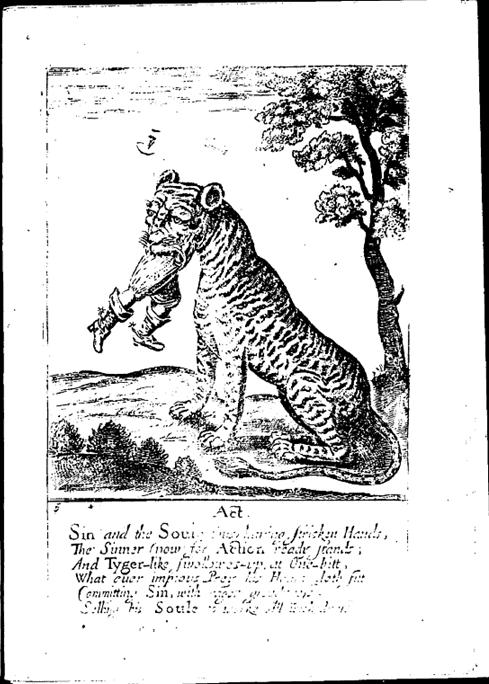
5 Act.
Sin and the Soul (thus) having stricken Hands, 
The Sinner (now) for Action ready stands; 
And Tyger-like swallows-up, at one-bit, 
Whatever impious Prey his Heart doth fit: 
Committing Sin, with eager greediness, 
Selling his Soul to work all wickedness. 

Sin in action is this splendid 'Tyger' (I suppose Blake scholars might have put the point that Blake might have seen this engraving), gobbling down its prey, boots, spurs and all.


Iteration. 6
From eager-acting Sin, comes Iteration, 
Or, frequent Custom of Sins perpetration; 
Which, like great Flesh-Flies' lighting on raw-Flesh, 
Though oft beat-off, (if not killed) come afresh: 
Hence, Be'lzebub is termed Prince of flesh-flies, 
'Cause Sin, still Acts, until (by Grace) It Dies. 

This unsavoury image of a menace to public health is a butcher trying to keep flies off his meat with a fly-flap. Our sins are now like flies, they will not go away, but, chased off, come buzzing right back.


GLORIATION. 7

Custom in Sin takes Sense of Sin away, 
This makes All-Sin seem but a Sport, a play: 
Yea, like a rampant-Lyon, proud and Stout, 
Insulting  o're his Prey, stalking about, 
The Saucy-Sinner boasts & brags of Sin. 
As One (oh woe) that doth a City win. 

'Gloriation', rare or obsolete says the OED, a splendid word meaning, or course, boasting of our actions, proud as a lion over what we have done.


8 Obduration.

When Sin brings Sinners to this fearful pass, 
What follows, but a hard heart, brow of brass· 
A Heart (I say) more hard then Tortoise-back; 
Which, nether Sword nor Axe can hew or hack; 
Judgements nor mercies, treats nor threats can cause 
To leave-off Sin, to love or fear Gods Laws. 

Oh dear, now we are hardened in sin. Like a tortoise, nothing can get through to us, we are obdurated in it (OED says 'obdurate' was a word to express hardening of the soul before it had anything to do with anything merely material in nature simply being made harder).


9 FINAL IMPENITENCY.
And (now, alas) what is Sins last Extent? 
A hard-Heart makes a Heart impenitent. 
For, can a Leopard change his Spotted Skin? 
No, nor a Heart accustomed (thus), his Sin. 
Then, Conscience, headlong, casts impenitence, 
With horrid frights of Hellish Recompense.

Can a leopard change his spots? Neither can a sinner. The leopard/sinner is I think meant to be committing suicide, driven by conscience into a final sin.

Setting off with original sin, and ending with conscience leading us to kill ourselves, 'The stages of sin' has little space for positives (but it does manage to mention repentance and grace). The animals are, however, quite jolly in some of the illustrations, and are generally doing what's natural to them


Tuesday, 29 March 2016

Ezekiel Culverwell's abbreviated Bible


Ezekiel Culverwell! How could he not have been what he was, a pillar of godliness (as the ODNB joint life of members of the Culverwell family calls him)? Their lives read together like a godly version of Wolf Hall, religious radicals who achieved, via the founder of the family success, Ezekiel's father Nicholas, great wealth, which they deployed to organise, disseminate, foster their beliefs and community.

The long-lived Ezekiel, son of this purposeful father, strikes me as carrying a businesslike outlook into his religious writings. Capable, diligent, he can achieve something that probably makes him unique in his age: being succinct about faith and the bible. Yes, his Treatise of faith concerning Perseverance runs to a more normal 527 pages (followed by a methodical authorial index of the principal contents), but his popular Way to a Blessed Estate in this Life runs to 17 short pages

I was first struck by his A ready way to remember the Scriptures. Or, A table of the Old and New Testament. By that late able, painfull, and worthy man of God, Ezekiel Culuervvell, minister of the Word, 1637. This was printed, as it says, after his death in the same year as John Donne, 1631, but there was clearly an earlier edition, for the introduction comes from Culverwell's pen, explaining what he had set out to do, how well it had worked for him, how the aide-memoire came to the press, what it can be used for, and what it will ensure. Look at his stress on 'chief' matters, principal matters:

"Having many years ago gathered and made this brief Collection of all the principal matters contained in the New Testament, whereby I may say (I lost not my labour) for I found it by good Experience no small help unto me; for by it I could easily find any principal matter; Now although the chief use thereof be for Divines and young Students, yet upon the desire of many good Christians, which have found the like fruit and benefit, I was willing to publish the same and make it more common; unto whom I wish, that reading over the New Testament, they diligently observe the contents and chief matter contained in every Chapter and Verse, and often repeat them over, and every day to go through some Chapter or other; and the better to keep the Contents in memory, to say over daily that which is past; whereby I have good proof, that by this means, in short time one may readily tell what are the Contents of any Chapter, and where any special matter is written, (which I conceive may be a good Exercise for the training up of Children of ten years old and upward) for by reading over these Contents, a man well exercised in the Scriptures, may in one hour see the principal matters in the whole New Testament: One special use thereof will be this to fill the Head, and so the Heart, with much heavenly matter, which is the best way to keep out idle thoughts. And therefore now having my hearts desire in what I did expect, I have thought good to publish the like on the Old Testament." 


Culverwell created a vade mecum to both Testaments, first to the New, then to the Old.


Above, he sets about Genesis. Recall, this isn't intended as a summary, but rather an orientation to the Bible's full contents, partly a guide by topic, partly by memorable events or words, so Genesis chapter 3 boils down to "3 Fall, 6. Punishment, 16. Cursed, 17. Thrust out of Paradise, Vers. 23."

Here, below, a double page spread from his reduction of The Book of Job:


There's no nonsense about it: here's some of the prohibitions in Leviticus, with Culverwell not mincing his words:


There's occasionally an aspect of a found poem, as when Ecclesiastes 10 is given as: "Dead flyes, 1. Folly in Ruler, 5. Speech, 12. King a childe, 16. Curse not the King"


Just how effective he is can be grasped from a double spread from his first completed section. this is from the Acts of the Apostles. We see him reduce Chapter 12 to "Herod, 1. James, 2. Peter, 3. Iron gate, 10. Rhode, 13. Herods oration, 21. Wormes, 23. Sauls returne, Vers. 25."


The 'Iron gate' is indeed the thing anyone would remember as the angel helps Peter escape from Herod's prison: "When they were past the first and the second ward, they came unto the iron gate that leadeth unto the city; which opened to them of his own accord: and they went out, and passed on through one street; and forthwith the angel departed from him", while verses 21 through to 23 read in full:
And upon a set day Herod, arrayed in royal apparel, sat upon his throne, and made an oration unto them.22 And the people gave a shout, saying, It is the voice of a god, and not of a man. 23 And immediately the angel of the Lord smote him, because he gave not God the glory: and he was eaten of worms, and gave up the ghost.

Not that our 'painful and worthy man of God' was a corner-cutter. This was an aid to your Bible knowledge, to help you get to the chapter you wanted to consult, it saved time for the serious business. And the serious business was indeed just that. In his characteristically titled

Time well spent in sacred meditations. Divine observations. Heavenly exhortations Serving to confirme the penitent. Informe the ignorant. And, cherish the true-hearted Christian. By that late able, painfull, and worthy man of God, Mr. Ezechiel Culverwel minister of the Word. (1634), Culverwell sets out a working day for a true, believing student of the Bible:

"Students.
This course have I by experience found profitable, and resolved upon, namely to be diligent in reading the holy Scriptures, and of them at the least every day four chap|ters; in like manner (for the increase of my knowledge) to spend three hours in the forenoon in searching out the sense of the hardest places, as two in the afternoon in the searching out the proprieties of the tongues, and other two in perusing the tracts and commentaries of learned men; one in meditation and prayer; what time remaineth to spend the fame in brotherly conference."

I'm rather charmed that anyone dared abbreviate the Bible, even as preparation for complete mastery of the holy text. Generally, their commentary and extrapolation piles up, like Hamlet's Ossa on Pelion.


Saturday, 13 April 2013

‘Their eyes were holden that they should not know him': J H Glaser's anamorphic Fall, 1638


This is Johann Heinrich Glaser’s anamorphic composition, ‘The Fall’, 1638, dedicated to the Rector of Basle University, a man called Remi Fasch.


I sourced the image in Jurgis BaltruÅ¡aitis’ Anamorphic Art (1977), following up a reference in Stuart Clark’s 2007 book, Vanities of the Eye. I post this because I tried to find the image somewhere on the web, but failed apart from a couple of impossibly small-sized reproductions in Google books. (I haven’t been able to source a copy of Fred Leeman’s Hidden Images book of 1976, which may have a better version.)


So, this is two scans merged together of one A3 sized photocopy of a double page reproduction in a book. I then fastened my long strip to a piece of plywood with blu-tack, and tried taking oblique photographs from the principal point of view you must use if the anamorphic face of Christ crowned with thorns is to appear.


Well, much has been lost in this series of reproductions. I did my best; it conveys the idea. There’s no angle that gives a better view of the image of Christ, without those alarmingly dissimilar sized eyes that is. BaltruÅ¡aitis does not give the original dimensions of the 1638 print. Judging by the size of the letters in the dedicatory inscription that runs along the bottom, I’d guess at twice the size of the reproduction, which is 40cm across in the book. The real thing must work far better than the reproduced version. Clarity in this case is everything, if the eye is to be deceived.


So, within these limitations, I think we can see, reading across from the right, Adam and Eve at the forbidden tree, with a large and properly serpentine (rather than Lamia-like) serpent coiled round the tree trunk, while an owl sits on a branch, and a peacock stands at their feet. Between them, Death rises up as they disobey God.


The animals: an ape gazes at the lake, but it is viewing the ‘vexierbild’, the puzzle-picture from the wrong side: the ape will not see Christ (as if the picture demonstrates that it lacks a soul). On this side of the lake, and nearest the act of transgression, foxes, a bear, a cow, rabbit, a cat and a dog sparring. Behind these animals, a half-hidden row of birds: what might be a toucan (known from the mid 16th century), two ibises, a cockerel with two rather exotic hens, a bird with a crest, a pheasant, a turkey, and a sprawling alligator. Then at the far left, the angel or cherubim chases Adam and Eve out of Paradise, the serpent wriggles at their feet, ready to start receiving its curse, and Death encourages their flight from Eden into his realm.


The lobe-like shores of the lake are of course where the anamorphic, hidden Christ begins. As a lake in Eden, He enlarges the usual four source streams of Paradise, usually depicted as clear rivulets stemming from a fountain, and usually allegorised as God’s grace flowing out to the whole world (the Pison, Gihon, Hiddekel and Euphrates, as Scafi’s book on Medieval maps explains, being taken to water all countries). Man’s sin has the reservoir of grace ready, the redeemer will not be revealed for millennia, but His mission, for which He is ready, has started.


Glaser has found a new way to put the two Adams into one picture (“First, wee see the difference between the two Adams: the first made sin, and infected all the world with it: The other made no sin, but redeemed all the world from it”, wrote Nicholas Byfield in 1623, it was a favourite thought of Donne’s – and of course many others).


There must be a larger study of unrevealed or half-revealed Christs. That Christ’s divine nature was hidden during His incarnation is one regular idea. But Christ is repeatedly not seen, or unrecognized. My title for this post comes from Luke 24, verse 16, non-recognition on the road to Emmaus; Mary Magdalene does not know him at John 20 14-16. At the start of His mission, in Like 4, 28-30, in one verse, Jesus is about to be cast down from the top of the hill by those angered by His calm self-announcement (after He has read from Isaiah in the synagogue, ‘This day is this scripture fulfilled in your ears’), and His apparent refusal to show His ministry in Nazareth: the next verse, He has somehow slipped away through the angry mob: Jesus autem transiens in medio illorum, the line medieval travellers liked to have on their good luck charms.


There ought, really, to be more early modern pictures like this. The Reformation’s iconoclasm made depictions of the godhead controversial. This was a perfect way to compromise (you’d have thought): Puritans, all you see is a landscape, Anglicans, squint in from the left frame. But I guess they were so much one or the other, compromise never appealed that much.

‘And their eyes were opened, and they knew him; and he vanished out of their sight.’ (Luke 24, 31)


Saturday, 26 January 2013

Zachary the slacker


Zachary Bogan, of Corpus Christi College, Oxford, was a consumptive (he lived to be just 34), and seems to have been subject to depression; “I have been in a manner buried alive in melancholy, and spent my dayes in vanity. My distemper was such, as did not onely render me indisposed, by study to gather more knowledge then I had before (being not able for whole moneths together, to perswade my selfe to take a booke in hand…” (One has to sympathise, even if only as a blogger who has neglected his blog for months.)

For a conscientious believer of the mid 17th century, a depressed state must have been heightened by their sense of Christian duty, of how vital it was to use your God-given talents (and Bogan, a probationary fellow at Oxford , was undoubtedly learned): “It was one of those things, which in my melancholy, my dejected spirit dwelt longest upon, that I had done God, and my brethren no service, having lived so long. 

His first attempt at what we would regard as pious self-therapy came after “a year or two” of depression: “It pleased the Lord (who, I cannot say, did ever hide himselfe in my trouble, or despise my affliction; but was ready to know me in all my adversity) to set me in a way, wherein I might spend my time better, and passe thorow with more ease, some of the rest of those wearisome dayes, which he had appointed for me.” So Bogan, suffering malignant sadness, wrote his first tract, Meditations of the Mirth of a Christian Life (1653).

These meditations his mother asked him to put into print, and he dedicated them to her. In his own rather ingenuous account, in the course of seeing the work through the press, he got talking to his bookseller while looking at a book about God’s promises (possibly The Saints legacies, or, A collection of certain promises out of the word of God collected for private use, but published for the comfort of God’s people, by A.F.), and “I asked the Bookeseller, whether he knew of any Treatise of his Threats. Being answered (contrary to my expectation) that he knew of none; I was the more earnest to inquire further. And so I did; but could heare of none. Whereupon I told my Bookeseller, that I resolved forthwith to read over the Bible, and make a collection of them my selfe; and, if it pleased God to incourage me in it, to print them.”

The work poor Bogan was inspired to write would appear in print, very rapidly, as A view of the threats and punishments recorded in the Scriptures, alphabetically composed (also 1653). Once started, he seems to have worked with manic intensity: “in very little more then a fortnight’s time, that by the help of God I read the Bible over: and reduced every thing that I observed, to a certaine head, in Alphabeticall order. After this, I examined every place of Scripture, by the Originall, and the most noted Translations.” 

He records for his general reader the “marvellous encouragement, which it pleased God to afford me all along in this worke”. While, in his sickness, he had barely been able to read for a quarter of an hour, now he found himself “supplyed with a constant delight in what I did, and a desire to goe further. If at any time I was weary (as sometimes I was quite tired, through infirmities of body, and want of spirits) as soone as I had but turned aside, but a few minutes, I found a sudden supply of desire to follow my businesse againe, as fresh as ever.”

Bogan’s book is interestingly unreflective. He does not make any explicit connection between his own situation and his subject; he does not consider what he might be being punished for. Here he is on what he, if pressed, might have considered his own sin, ‘Unfruitfulness’, and it serves as a typical entry from the treatise. Under the heading (‘Unfruitfulness’), he makes a list of how “God punisheth men for it”. The divine punishment for unfruitfulness proves to be just an infliction of more of the same:

1. With leaving them to the wide world. ‘What could I have done more to my vinyard, that I have not done in it? wherefore when I looked that it should bring forth grapes, brought it forth wild grapes? and now goe to, I will tell you what I will doe to my vinyard, I will take away the hedge thereof, and it shall be eaten up, and break downe the wall thereof, and it shall be trodden downe’ Isa. 5. 4, 5.
2. Taking away the means of making them fruitfull. I’t shall not be pruned nor digged: but there shall come up briars and thornes, I will also command the cloudes that they raine no raine upon it’, ib. v. 6.
3. Taking away the power and meanes of being fruitfull (gifts and talents.) ‘Take therefore the talent from him, and give it unto him that hath ten talents’, Mat. 25. 28. So that for unfruitfullnesse the sinne, they have unfruitfullnesse the punishment; ‘When he saw a fig-tree in the way, he came to it, and found nothing thereon, but leaves only: and said unto it, let no fruit grow on thee hence forward for ever and presently the figtree withered away’ Mat. 21 19.
4. Cutting downe, as trees that have left bearing. It was John the Baptist’s doctrine, ‘every tree which bringeth not forth good fruit is hewen downe and cast into the fire’, Mat. 3. 10. And it was our Saviours too, in the same wordes, chap. 7. 19. Luk 13. 7. He that had hid his talent in the ground, had his doome to be cast into outer darknesse, Mat. 25. 30.

I have said that the book is unreflective, from a modern point of view, in Bogan not seeing the connection between what he is doing, and his own condition as a man. He just doesn’t ask himself why he is suddenly energized by just this topic. A pious-minded consumptive and depressive somehow cannot see a connection between his list of God’s punishments and his own situation.

But the other unreflectiveness about the book is that Bogan does not seem to have considered the overall effect his work would have. From the point of view of any conventional piety, the book is crassly conceived (if we take the notion that ‘God is Love’ as the basic persuasion of the ordinarily pious). Bogan blithely ploughs on, assembling God’s punishments for the various failings of His accursed creation. (Maybe I am the naive one here, and that Bogan's work was at some level a subtle striking back at God.)

Of course, open the Old Testament at random, and you will generally find a whole lot of smiting going on. Assembled together, the vindictiveness, the indiscriminate retaliations, the irascibility, gross favouritism, the general moral insanity of the Godhead becomes the foreground, the middle, and the background - to say nothing of the continuous recourse of the Almighty to horrible threats.

So here’s a selection of Bogan’s examples. In brackets, I give the sin, and then examples of the punishments Bogan eagerly collected from the Bible:

(Whoremongering) “When the Israelites committed whoredome with the Moabites, God (by a disease, or fire, or some other extraordinary plague) slew no lesse then foure and twenty thousand of them, Num. 25. 1, 9.”

(Adultery) “If those that commit adultery escape death, a thousand to one that they escape these ensuing punishments, viz. 2. Retaliation, or being done to as they have done to others thus David was punished, Thus saith the Lord, behold I will raise up evill against thee out of thine own house, and I will take thy wives before thine eyes and give them unto thy neighbour, And he shall lie with thy wives in the sight of the sun’ 2 Sam: 12. 11.”

(Talkativeness, punished by) “2 Destruction (as by discovery, provocation, & an hundred otherwayes) ‘He that keepeth his mouth, keepeth his life but he that openeth wide his lips, shall have destruction’, Prov: 13. 3” 

(Not being improved by the punishment meted out to you) “And I also have given you cleannesse of teeth in all your cities, and want of bread in all your places: YET have yee not returned unto me saith the Lord.”

(Being a disobedient child, punished by) “Stoning to death. If a man have a stubborne and rebellious sonne, which will not obey the voice of his father, or the voice of his mother, and that when they have chastned him will not harken unto them: Then shall his father and his mother lay hold on him and bring him out unto the Elders of his city, and unto the gate of his place. And they shall say unto the Elders of this city. This our sonne is stubborne and rebellious, he will not obey our voice, he is a glutton, and a drunkard, Being rebellious is the maine crime, and being a glutton and a drunkard, are brought in as evidences, though crimes too) And all the men of his City shall stone him with stones that he die.” 

(Being an enemy to Christ) “He that sitteth in the heavens shall laugh. The Lord shall have them in derision Ps. 2, 4. Oh fearfull threat! how sad is the condition of those men at whose calamitie God rejoyceth! or at whose wickednesse he laughes! suffering them to run on in their sinnes because he seeth that their day of punishment is coming Ps. 37, 13. Give me any anger, rather then a laughing anger, whether of God, or man. See the threats Ps. 59, 8. Prov: 1, 26.

(Curiosity) “He smote the men of Bethshemesh, because they looked into the Ark of the Lord: even he smote of the people fifty thousand, and threescore & ten men 1 Samuel 6, 19. wicked men commonly are more desirous to know the things of God in a way of curiosity then godly men”

(Murmuring in dissent) “while the flesh was yet in their teeth, ere it was chewed, the wrath of the Lord was kindled against the people, and the Lord smote the people with a very great plague”

(Incest punished) “With Losse of Birth-right. For thus Jacob (as he was dying) cursed Reuben, for lying with (his Concubine onely) Bildad. ‘Unstable as water, thou shalt not excell, because thou wentest up to thy father’s bed; then defiledst thou it: he went up to my couch.’ Gen. 49. 4.”

(Mocking of God’s ministers, punished with) “1. With Wrath unappeaseable … 4. Violent death by wild beasts. ‘As Elisha was going up to Bethel, There came forth little children out of the city, and mocked him, and said unto him, Goe up thou bald head, Goe up thou bald head. And he turned backe, and looked on them, and cursed them in the name of the Lord, and there came forth two shee beares out of the wood, and tare forty and two children of them’, 2 Kings 2. 23, 24”

(Injurious dealing, punished with, number 4) “Destruction of the whole world, (which otherwise perhaps had not come before God, so soone as it did:) ‘The earth is filled with violence through them, and behold I will destroy them with the earth’, Gen: 6. 13.”

Bogan industriously turns a basic tenet of his faith inside-out. God is hate.

We can only imagine what Bogan’s clerical contemporaries might have said about the exercise. His tract found its way into the library of Baron Brooke, among the ‘Divinity English in Octavo’ (Catalogus librorum ex bibliotheca nobilis…). Perhaps people we simply less sensitive – what was in the Bible, after all, was in the Bible, and so beyond question. Maybe it was in fact regarded as a valuable guide: if you wanted to denounce some sin or other from your own pulpit, as must have happened in most parishes on most Sundays, here was a quick route to the relevant divine combination.

And, of course, the Bible is just rather good at these things, infinitely wise, pithy, apt. Just look at the texts cited in this last list of God’s punishments:

Company of any too much keeping it punished with hatred: ‘Withdraw thy foot from thy neighbours house lest he be weary of thee, and so hate thee’ Prov: 25. 17.

Gluttons punished by “Loathing of that which they loved. ‘The full soule loatheth the honey-comb’ Prov: 27. 7.”

The Idle, susceptible to “Continuall desiring, and not having their desire: which must needs be a great punishment, because it is a great vexation. ‘The soule of the sluggard desireth, and hath nothing’, Prov. 13. 4.”

Lying, punished by “2 Discovery in a little time. ‘The Lip of truth shall be established for ever: but a lying tongue is but for a moment’, Prov. 12. 19.”