Showing posts with label Mobile phone. Show all posts

Thursday, 2 June 2016

ESPN launches multi-sport India-specific website and mobile app

Sports websites are dime a dozen; and one of the popular ones is ESPNCricinfo. But it is only about cricket. Early today, ESPN launched an India-specific, multi-sport website and mobile application.

The website is branded SONY ESPN but the URL is http://www.espn.in/ and the app, available for now on Android and iOS, is called ESPN.

The ESPN mobile app existed before. What has changed today, with an update, is that it's got India-specific content too, besides the hitherto, predominantly American content.

It's like the ESPNCricinfo website, but it has got a much sleeker look, and has got a whole lot of content, drawn from the huge data repository of ESPN, which has only gotten much larger after its collaboration with Sony. So besides cricket, football, tennis, there are also NFL, NASCAR, shooting, chess, hockey, badminton, wrestling, kabaddi, etc.

Like all good websites and apps, this too can be personalized. Once signed in, we can choose our favourite  sports, leagues and teams. We can go to the favourites tab and follow scores, news, images, videos etc related to them. And like all the other good websites and apps, the selections sync across all the other devices -- mobile, tablet, laptop, desktop.

Besides all this, both the espn.in website and the app, will stream live sports events for which Sony has the broadcast rights. This is in association with Sony LIV. We can look forward to live video of the UEFA Euro 2016 on the espn.in website and also on the app, besides of course Sony ESPN TV channel.

ESPN International has 26 television networks and additional businesses like radio, print, internet, broadband, wireless, consumer products, and event management, in over 61 countries. Globally, it is headquartered in Bristol, and in India it is headquartered in Bengaluru, with offices in Mumbai and Delhi. ESPN is 80 percent owned by ABC, Inc., which is a subsidiary of The Walt Disney Company. The rest is held by The Hearst Corporation.

Monday, 15 June 2015

Missing, last seen on WhatsApp

Recently, my friend from Kolkata narrated an anecdote that happened in his neighbourhood.

A 20-year old college student went missing. He had returned after studies, but went out soon after, saying he was going to meet a friend. But neither did he mention anyone's name nor people at home ask. When he wasn't back even after 10 pm, folks at home began to get worried.

They called him on his mobile. But the calls repeatedly gave an 'out of coverage area' reply. Friends too tried, but to no avail. Messages too evoke no response.

A friend thought of checking WhatsApp. The Last Seen time stamp was only 10 minutes behind the actual time. That meant he was active on the messaging app. But the friends couldn't figure out why he hadn't bothered to inform where he was, but "was happily" WhatsApping.

A quick explanation was he might have tried to call or message but the mobile connectivity might have been bad. He might have been online as his data lines were more stable or he was on someone's Wi-Fi.

No sooner his friend noticed the missing boy's time stamp change to 'online' than he shot off a message.

"Where the hell are you? All are worried."

To the delight of everyone, he replied.

"I am at (a friend's) house. Don't worry. It's raining heavily here. Can't step out. Will come once rain reduces."

"Then why the **** you didn't tell anyone at home ...."

"Chill. Nothing to worry. Call wasn't going through. Will call now. Or you also tell them."

Apparently it was true that in the other part of the city, it was raining, and he was genuinely stuck.

He was back home around midnight to a lecture on how he should remember to keep someone posted on his whereabouts if he wasn't where he normally should be.

But the other takeaways from this incident were: one, how internet-based messaging platforms can help when the default phone call and SMS don't seem to work; and two, perhaps, more significantly, the clue the time stamp on Last Seen can provide about your status.

The above anecdote was narrated by my friend during a recent dinner get together we had with a few of our common friends, when he visited Bengaluru. His story triggered a debate on whether the Last Seen feature is an invasion of privacy or it is helpful.

Here is a gist of the arguments: some on predictable lines, some new lines of thought.

Against Hiding
  • Since when is WhatsApping a crime?
  • Why should I care if someone knows when I checked WhatsApp last? How does it matter to anyone? I might check at 1 in the afternoon or 4 in the night.
  • WhatsApp is not like Email. It is an instant messaging platform used for quick communication. So Online and Last Seen are important indicators, that show how easily I can be accessed.
  • Hiding doesn't serve any purpose anyway, because the double tick will indicate that I have got the message. And the blue tick (if I haven't disabled that) means I have read it too. So, what is the big deal? What am I trying to hide anyway?
For Hiding
  • Since it's an instant messaging platform, I am online most of the time. Then, why publicize additionally the precise timings too?
  • It's a system prone to technical issues, and not reliable. One, if the app is running in the background, especially on Android phones, I might be shown as online, when I am not actually. Two, if I only opened the app, and not read or typed a message, sometimes the Last Seen gets updated. Three, when using the web version, sometimes you are shown online, even when you have minimised the browser. The Last Seen feature is flawed and misleading.
  • Some people expect a reply from me immediately (on seeing that I have been online), when actually I haven't had time to type out a reply. 
  • Suppose I was chatting late at night with my friend in the US, my mom wants to know why I wasn't sleeping, and with whom I was chatting late in the night! Mom I can handle, but why should everyone else too know that I was up late into the night. It's total invasion of privacy. A provision to make oneself invisible is what is actually needed.
All of these finally got washed down with a few drinks and a generous helping of some Continental and Chinese delicacies.

Wednesday, 1 October 2014

5.9 inch Nexus 6 on Android L launch expected in October

In the last 24 hours there have been more information trickling out about the much-anticipated next Nexus phone. (Though Moto G and Moto X created lot of excitement because of stock Android, Nexus still spells magic.)

An earlier post on the next Nexus phone is here.

One of the first things I look for is the screen size, because I read a lot. At 5.9 inch, Nexus 6 will be a giant phone. Incidentally, HTC One Max has the same screen size. A phone of this size will be difficult to hold. I would have preferred a maximum of 5.5 inch. May be reading experience would be better.

That reminds me: When Galaxy Note (now referred to as Original) hit the market end of 2011, an enthusisatic sales guy tried his best to make me buy one. But I found the screen size of 5.3 inch too big. I even remarked to that guy, who would buy such an huge phone!

In Jan 2013, at one of the elctronic stores, when I saw the same Galaxy Note, I was surprised seeing the size of the screen. I asked the sales guy, "Is this really Galaxy Note, the original one?" (By then Galaxy Note 2 was in the market.) He said, yes. I thought the size of the screen looked smaller than what I thought it was. Of course, it was just perception. 5.3 inch in 2011 was huge. The same 5.3 inch in 2013 looked quite normal.

So, though now I think the Nexus 6 screen size of 5.9 inch is huge, may be I will have to revise my opinion a couple of years later, when most phones would be of around 6 inch!

Nexus 6 will have top resolution of 2560x1440.  LG G3, Oppo Find 7 and Samsung Galaxy Note 4 have similar resolution. Galaxy S5 has 5.1 inch screen with display of 1920x1080. Galaxy Note 4 has 5.7 inch screen.

Another spec that I look for is the processor. Nexus 6 is rumoured to have Qualcomm Snapdragon 805 chipset, and will pack 3GB RAM.

Some other features are: 13-megapixel rear camera with optical image stabilization and a 2-megapixel front camera. The battery will be a 3,200mAh one, and it's said, a mere charging of 15 minutes will give it a life of 8 hours. That sounds simply unbelievable.

Like HTC One M8, Nexus 6 is rumoured to have front facing stereo speakers.

But the best part is it will run on Android's latest operating system, now called Android L, the successor of Kitkat. That will kickoff the Android 5 version.

The launch of Nexus 6 and Android L is said to be in a couple of weeks, in mid-October.

Now, we just wait for more clarity on all these rumours.

Tuesday, 16 September 2014

Too much hype: Android One is not one of its kind

Spice Android Dream One
Photo from Flipkart
Yesterday at a much-publicized event in New Delhi Google unveiled its Android One phones in India. There is quite a hype about it. Understandable. Don't be surprised if Android One gets dubbed as the poor man's Nexus or Moto X, as it has stock Android.

But there are other phones in the Android One category.

To begin with there's nothing so great about stock Android. What it means is that, those phones with stock Android will get the software updates directly from Google as and when they are released. In all other phones, the manufacturer like Samsung or Micromax will have release it for you. Phones with stock Android are Nexus, Moto G, X and E, and now the Android One.

For all practical purposes, these updates and upgrades aren't going to make any huge difference as far as the routine uses of a smartphone are concerned. All the common apps function perfectly well even on an Android 4.1. There are some apps that run only on the newer versions of the OS. But now all phones give you at least a 4.3.

Even if you thought you needed a stock Android phone, there is already one for around Rs 7,000. That's Moto E.

Now, let us weigh some of the specs of Spice Dream Android One phone, with Moto E, Samsung Galaxy S Duos 2 and Micromax Unite 2. All four of them are in Rs 6,000 to Rs 8,000 range.

* All four have dual SIMs. Spice Dream and Moto E have micro SIM.

* Spice Dream, Moto E and Micromax Unite 2 have Android 4.4 but the other has Android 4.2. But that should not really matter, unless you badly want to be with the latest version of Android, and you want to download some niche high-end apps.

* Duos 2 has 4 inch screen, Moto E 4.3, Spice Dream 4.5 and Unite 2 4.7 inches.

* Dream and Unite 2 have 1.3GHz quad core processor, while Moto E and Duos  have 1.2 GHz dual core. So, all are fairly powerful.

* All have 5 mega pixel camera. Only Moto E doesn't have front camera.

* All have 4GB and option to expand memory.

* Regarding battery, while Dream has 1700mAh, Unite 2 has 2000mAh, Moto E 1980mAh and Duos 1500mAh.

So, basically Android One is not one of its kind. I randomly looked at three phones for comparison, but any e-comm site will give you options of many other phones with good specs in the same category.


Wednesday, 27 August 2014

Shamu, Nexus 6 and Android Silver

If you say Shamu, most people will relate it to the whale that was captured in the 1960s. But for the few gadget geeks it's the name of the new Google phone that will hit the market later this year.

It's making waves because many people think Motorola Shamu, or Moto S, will be the successor to Nexus 5.

But what has added to confusion are reports that Google will discontinue the Nexus series, and that Moto S will be an Android Silver phone.

What is Nexus?

Nexus series (of phones and tablets) is Google's flagship Android mobile devices. These are informally called Google phones or tablets because though the devices are manufactured by Samsung or LG, they haven't been customized by the manufacturer. Additionally, since there is no third party intervention, so to speak, Android updates will flow in directly and immediately from Google itself, rather than being pushed by the device manufacturer. There are pluses and minuses of that.

What is Android Silver?

That is the new range of stock Android phones, which will replace the Nexus range. Reports say that these phones will have newer standards, different from what Nexus phones have, that will be of premium nature. What these standards are and how Google will enforce it is not known. For this range, Google is said to have tied up with Motorola, and the first device, Moto S, is expected to hit market in early next year.

A lot to watch out for in the coming days.

Tuesday, 6 May 2014

How smart are you with your phone?

All phones are now smart. If someone wants to buy one, and there are quite a few less expensive not-so-smart phones available, most people willy-nilly choose an expensive smart one. Nothing wrong in it.

But I wonder, how many people really make use of the smart features in their phone.

Everyone may not know all the interesting features a phone offers. So, if you have got yourself a smart phone, explore the device, and start making use of the smart features.
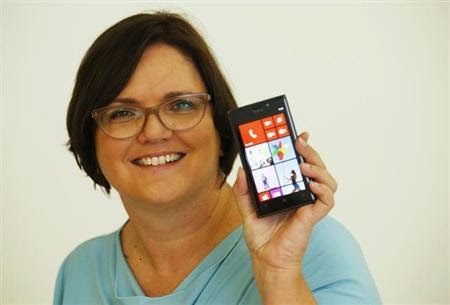
Most of the phones may be Android, but Nokia's Lumia series phones are equally good providing a slew of smrat features. The photo shows Nokia's executive vice president of smart devices Jo Harlow posing with the new Lumia 925 at its launch in London May 14, 2013. -- Photo credit: Reuters/Luke MacGregor
Let's take a common example, of Google Search in Android phone.

In phones that run on Android 4.1 (released in June 2012) and above, Google Search is integrated with Google Now.

What is Google Now?

It's a personal digital assistant -- the Android counterpart of Apple's Siri. It helps you with a lot of information, by quietly doing a search in the background. For example, it gets you the weather, it reminds you of appointments, it will tell you how long you will take to reach your office etc.

If you enable the Google Now function, then these information show up in the form of cards. Information becomes more and more accurate as you continue to use it.

But the best part is you can search Google by just speaking into the phone. Look for the "Voice Search" icon in the menu of apps. Just tap it, and ask Google whatever you want to know.

The process is so simple and the results are amazingly accurate as well.

Ask questions like:

  • What is the weather in Bangalore?
  • Who is the prime minister of Australia?
  • How much is 478 dollars in Rupees?
  • What is the height of Barack Obama?

Google will tell aloud the answers to all these questions.

You can also get the phone to do some functions too. Like, set the alarm. make a call. Just tell Google, "Set alarm for 7am tomorrow." Or, "Call Ravi Kumar".

Or even "Take a selfie". Google won't click the camera, it will just open up the camera, for you to pose, and then you can click yourself when you are ready.

There are many other smart features a phone possesses. For example:

Getting directions using Google Maps. There is no need to ask anyone the direction. And using a very simple function called MapMaker, you and I can enrich the map contents by adding landmarks, or even suggesting changes. In fact much of all that you see in the Maps has been added by users.

Maximize the use of apps. There are definitely many apps that suit your interest. Just check them out.

On a Lumia phone of Nokia, there is a Kid's Corner function which I like a lot. You can activate that function when you give your phone to children to play. You can include in that feature only those functions of the phone that you think the child should have access to. It's great feature in these times when children play a lot with elders' phones. They sometimes accidentally call others, or even wander into unsafe areas of Internet or download unnecessary files.

You can do pretty much everything with your phone. One of my friends got herself a "very basic" phone, that will just let her make calls, text, take photos, and listen to the radio. But the phone was smart. So, she has ended up discovering many interesting features, she never thought she would ever use in her life.

So, get smart with your phone.

Saturday, 1 June 2013

Not all autorickshaw drivers are bad

Autorickshaw drivers are a much-maligned lot. Very rarely do we come across one who is not rude or arrogant. But there are exceptions, which give us the much-needed hope.

The following is a Facebook post by Rita Senthil Selvaraj, who works with Cognizant Technology Solutions, posted in the last 24 hours.


I was for sure lucky today..
took an auto from koramangala to yemlur(my house), in between it started raining heavy. somehow i reached home safely and the driver u see in photo dropped me till the door step so that i don't get drenched. I was so excited to see baby that i made the payment and left my iPhone 4 (Gifted by my hubby on my birthday) in the auto..
after almost 35 mins I thought of making a call to my parents and here i don't find my phone. my hubby Senthil Selvaraj called from his cell to trace the phone n luckily the auto driver had kept the phone safe with him which he received.. he was dropping someone to whitefield but he promised that he will return the phone after the drop.. imagine heavy rain and the driver was so kind and honest that he dint think of his comfort.. he was not carrying any phone of his own. it took almost 1 hr for him to come back.. we generally dont trust auto drivers as they keep asking extra money, late night work and what not.. so with that mentality we used find friend and find my iPhone apps to trace the phone and the route of my iphone was sure to my house.. in that heavy rain he did come home and returned my phone..
We should seriously appreciate such people on earth.. and we do.. this auto driver's name is Zamir auto number KA 03 9847.. Thanks Zamir for being so honest and trustworthy.. and also to be a reason of making my day lucky.. 
Not all absent-minded people forget their phones in autorickshaws. And, rarely finders take the trouble to return the phone to the owner. Zamir's effort needs to be lauded. Hope we have many more people like him.

Monday, 26 November 2012

Be safe, your favourite app might be infected

Apps drive mobile devices. There’s one for everything, including one to detect a bomb! Apps are tricky in a sense, because they need access to your personal data in the device.

All apps ask for permission while downloading. Some are: access data network, call records, GPS coordinates, rights to modify contents of SD card, to start on reboot etc. On the face of it, they look harmless, and ordinarily most of us grant the permission. But problems crop when the apps have Trojans (a form of virus) hiding in them. With proliferation of apps, they are becoming a popular vehicle for viruses.

Earlier this year, Sophos security firm detected a trojanized version of the Angry Birds game. These are infected apps that resemble the original one, misleading people.

Having such apps is a risk. "Trojans can come disguised as wallpaper applications. They contain the malicious package within it and may be hard to uninstall," says Ruchna Nigam, Security Researcher, Fortiguard Lab.

"Zitmo is a well-known banking Trojan (it has Symbian, Android and Blackberry versions) that can receive commands from the attacker to intercept SMS second-factor authentication banking tokens and forward them to the attacker, thereby exposing users to banking fraud," she says.

Some apps, malicious ones particularly, seek permission for activities unrelated to their function. When a music app seeks access to call records, you must wonder why, and check the credentials of the developer. For all that you know, it might be safe app. But it’s a call worth taking.

Juniper Networks’ Mobile Threat Center analyzed over 1.7 million apps on the Google Play from March 2011 to September 2012. It found that in the cards and casino games category, 94% of free apps that could make outbound calls didn't describe why they would use this capability. Similarly, 84.51% of free apps that could send SMS didn't specify why they should do so.

In the racing games section, 99% of paid apps and 92.42% of free apps had rights to send SMS, while 50% could use camera and 94.54% could initiate outgoing calls -- without any explanation as to why they needed to do that, says Ravi Chauhan, managing director, Juniper Networks.

The survey found free apps were 401% more likely to track location and 314% more likely to access contacts than their paid counterparts. Among location-tracking apps, 24.14% were free, while only 6.01% were paid.

This gives an impression that free apps access info to target ads. But out of the 683,238 apps examined, the share those with top five ad networks was much less than the total number tracking location (24.14 percent). “This leads us to believe there are apps collecting data for reasons less apparent than advertising,” says Chauhan.

How to be safe
1. Avoid free, unsecured wi-fi. Strangers can peep into what you are sending.
2. Download from official app stores like Google Play or iOS.
3. Check if access permissions sought are needed. Trojanized apps seek more permissions than are required.
4. Check who the developer is.
5. Install mobile security app from known brands like Kaspersky, Norton, McAfee or Avast.

(This article was published in The Times of India, Bangalore, today).


Thursday, 22 November 2012

How to access internet via text messages

It’s not necessary to have internet connection on your phone to access the web. A mere text message sent to a particular number can get you basic data from sites like Google and Wikipedia. Text-based applications also provide information like live update of cricket scores.

Companies like txtWeb, Google and Innoz Technologies have such services.

At the heart of the technology is adoption of a different method to access the internet. These services are popular because of three reasons: one, majority of mobile phones in India are low-end ones with just ‘talk-and-text’ features; two, many people who have smartphones don't have a data plan; and three, those who have data plan, use it sparingly considering poor bandwidth and high cost.

In txtWeb, the keywords have to be sent to 9243342000. For example, to see the Wikipedia entry on Diwali SMS ‘@Wikipedia Diwali’. @cricket gives you the latest scores of cricket matches.

You can get the autorickshaw fare between two locations in a city -- for example, send ‘@auto fare Bangalore, Koramangala, M G Road’. Users can text ‘help’ or ‘txtweb’, to get a list of top apps, featured apps etc. The response sent to the user also contains many tips on how to make better use of the platform, says Manish Maheshwari, director, txtWeb.

Randomly sending a keyword also provides a list of applications related to that subject. Besides, a complete list of all the apps is available at ‘txtweb.com/ apps’.

Google has ‘SMS applications’, wherein simple queries can be answered by sending an SMS to 9773300000. For example, to know how much is one dollar in rupee, text "1 dollar in INR". Similarly, by texting "Bangalore weather", you get information like temperature, humidity, windspeed, sunrise time etc.

If you want the definition of a word, say, inflation, send an SMS ‘what is inflation’. Flight status and list of trains running between two stations too can be obtained by this service.

Another company working in this field is Innoz Technologies. It has developed an innovative operating system for mobiles that enables access to internet through SMS. All that users have to do is to send the keyword to 55444 to get the answer. The company is in talks with mobile phone manufacturers to have the Innoz OS preinstalled in basic phone models.

(This is article appeared in The Times of India, Bangalore, on Nov 20)

Wednesday, 21 November 2012

Personal computers are not dying

Desktops may be on their deathbed but definitely not any other personal computing device.

The original definition of PC referred to desktops, the complete set of CPU, monitor, keyboard, speakers, modem and voltage stabilizer. Now desktops have shrunk to laptops and netbooks (notebooks). PCs are seen different from smartphones and tablet; though mobile devices are highly personal and effective computing devices.  
 
The talk of imminent death of PCs is evidently prompted by the ever-growing popularity of mobile phones. Many people have two phones, or a phone and a tablet. But it’s no argument that personal computers, to mean laptops and netbooks, are dying.
 
In spite of all the advantages, mobile devices have their flip side. One, small user interface, because of the screen size. A 14- or 16-inch monitor of a laptop is definitely not the same as a 4-inch mobile screen. Higher dimensions of 5, 7 and 10 inch screens are a shade better. Besides, wider screens are easy on the eye.
 
Two, mobile devices generally work well for quick work on the go; a multitasking device that lets you talk, text, check mails and Facebook, send a one-line reply, do a web search, etc. But if you want to watch a 3-hour movie or live streaming of a sports event, or read or type a long document, the wider screen and broad keyboard of a laptop is more comfortable.
 
Three, screen navigation is easier when it comes to keyboard and mouse. Be it opening multiple tabs or copy-pasting text or working on photos or playing games, the superior user experience of a laptop is undeniable.
 
PC shipments in India grew by 4.9 per cent to 2.99 million units in July-September period of the current year over the previous quarter, according to global market intelligence and advisory services provider IDC. Even the netbook with 10-inch screen and much lower processing capacity compared to the laptop, was supposed to have flopped but that’s not the case. Many people possess both netbook and laptop, and use each for different purposes.
 
But it is a fact that PC shipments have slowed over the past few years. One, most people have a laptop. So the boom-time, first-acquisition numbers have tapered. Two, with tablets and other options, use of laptops have reduced, making them last longer. So, the replacement-buy is delayed.
 
Personal computers will be around for some time. Multiple devices is the norm -- each being used for a specific purpose. Nevertheless, a time may come when the nascent convertibles, a cross between mobile phones and laptops with detachable keyboards, would replace laptops. But that is quite some time away. At least now, it’s too premature to say PCs are dying.

(Crossposted from Kaleidoscope)

Wednesday, 5 September 2012

Mobile TV apps


Mobile TV Applications let you watch live scores of TV channels like NDTV and BBC to Asianet and Cartoon Network on your mobile phones. For some apps, you don't even need the much-hyped 3G connection. It works well on 2G.

It's amazing how you can now watch the serials and news while travelling in car or while lying on the bed!

Here is the link to my article in The Times of India

http://goo.gl/cwHno

Monday, 11 June 2012

Gaming company Zynga aims high on mobile phones

From playing alone, to playing against a computerized opponent, to now playing against real people, be they friends or strangers: it's a whole new genre of social games. The biggest boost it got in recent times was arguably the epidemic spread of Farmville over Facebook. And Zynga can claim some credit, for it was their creation.

One of the leading players in the industry, Zynga says it aims at connecting the world through games across multiple platforms and devices. Apart from Facebook, gaming enthusiasts, now can have access to their games anytime and anywhere on several mobile-enabled platforms giving mobile game developers the opportunity to grow tremendously.

It has a growing portfolio of mobile social games for both iOS and Android including recently launched Draw Something, Scramble With Friends, Dream Pethouse and Dream Heights.

In Bangalore, Zynga has its second biggest studio in the world, after the one at their headquarters in San Francisco. It opened in 2011, and a lot of mechanisms and features across an array of the most popular games are developed in Bangalore. Zynga India has more than 200 engineers and creative professionals.

Sean Uberoi Kelly, Vice President of Product Development at Zynga, was in the Bangalore studio recently. Here are the excerpts from an interview:

On Zynga’s new strategyOne of our philosophies is to go where the audience wants us to go. People are increasingly playing games on mobile devices, and now we are striving to have a big presence there. We launched a number of mobile titles in the last few quarters.

We acquired Draw Something, we launched last year Scramble with Friends. Another is Zombie Smash which which has come out on Android. We think Android is a great platform and we have a number of games on Google play.

As people are getting connected through smarter and smarter phones such as the iOS and Android ecosystems, they are also looking for new ways to be social through games.

The mobile presence
Zynga has been on mobile devices since 2010. Our first mobile game was Farmville on the iOS platform, and since then we have produced many games. We have more than 21 million active users on mobile devices. 

Factors spurring mobile gamesStrategically, we have seen three factors that have contributed to the success of mobile games. One, the app economy. Different platforms allow different experiences to be launched from them. It's not just about the browsers. There are now other capabilities like touch.

Secondly, we have a new business model that is the user-pay economy. Here the users don’t have to buy a game upfront. Our games are free, but if a user wants to play at a higher level, or derive more fun out of it, or if he wants to buy some goodies, then he can pay for them.

The third is the new set of devices that enable people connect socially. They allow you to connect with your friends. Like Words with Friends. I may not call up my friend every day to talk to him, but I can play games with him, that is more fun way to keeping in touch. This is a trend we think will grow in the years to come.

Web vs mobile
We look at mobiles as a unique space. We don’t believe that just because a game is right for the web, we should automatically put it on the mobiles. because there is a lot of difference in the way we interact with our friends on the mobiles.

On mobiles you can play anywhere. Secondly, on the mobile you tend to play more and in a different way. A game on a PC may be one that you play during your coffee break. But on a mobile you could be playing while walking down the hall or just for a minute on your way back home, or just before you sleep. Also, you can get in and out quickly out of mobile games, unlike on a PC.

Limitations of mobile appsA mobile screen that is only as big as a business card, is a huge challenge for a developer and designer. The interface has to be different. But mobile devices have grown impressively. Like they now have hardware accelerators, and you get experiences comparable to what you would get on a laptop screen. So technology hasn't been a really obstacle.

The India story
india is important to us in two ways. As a technology company we have a lot of developers. We have now a private cloud in addition to the public cloud, and India has been a major contributor to the development of the private cloud.

We do a lot of analytics here. We track data and get valuable info on how games are being played. And we also do a lot of software work here that helps us run our business well.

Six of Zynga’s global games are operated from the Bangalore studio. They are: Empires and Allies, Mafia Wars, YoVille, Treasure Isle, FishVille and Vampire Wars. The two latest mobile games developed in Bangalore are: CityVille HomeTown and Dream Zoo.

Bangalore, the only studio in India, is cross functional; meaning, we have the technology team here, there is the gaming team here and also a business team here. That is not the case usually in an external environment. but the technology infrastructure in Bangalore is so good that we are able to grow faster here.

Third-party initiativesIt’s not necessary that we should make all the games. We have announced some third-party initiatives. We recently launched our own platform zynga.com that will enable players to discover and play social games created by third party game developers. There are six publishers who have lined up with games for that platform. We will only be happy to connect with others.

(This article appeared in The Times of India, Bangalore, today)